

1. FREE PMP® Exam Questions
This course offers 50 selected practice questions, reflecting the most current format and content for the PMP® exam. You’ll not only get instant feedback on your answers but also detailed explanations to ensure you fully understand the rationale behind each question.
2. PMP® Exam Updates
New PMP® Exam Launching July 9, 2026
The PMP® exam is evolving to better reflect today’s dynamic project environments. Here’s what you need to know about the upcoming changes—and how they impact your preparation.
Content & Focus Areas
- New topics introduced, including AI, sustainability, and advanced stakeholder engagement
- Stronger emphasis on delivering outcomes and business value, not just processes
- Greater focus on real-world application of project management skills
Updated Domains & Weighting
The exam structure is being rebalanced to better reflect modern project demands:
- People: 42% → 33%
- Process: 50% → 41%
- Business Environment: 8% → 26%
This shift highlights the growing importance of strategic thinking and business alignment, alongside leadership and technical expertise.
Updated Approaches & Weighting
The percentages within the approaches have changed.
- Predictive: 50% → 39%
- Agile: 23% → 29%
- Hybrid: 27% → 32%
This shift highlights the growing importance of adaptive decision-making in complex environments, with scenarios that reflect real project challenges rather than theoretical knowledge.
Updated Eligibility Criteria
- More inclusive global alignment across degrees, apprenticeships, and training programs
- Experience requirement: 3–5 years
- Eligibility window extended to 10 years, giving candidates more flexibility
Exam Experience Enhancements
- 180 questions over 240 minutes
- More interactive and scenario-based questions
- Designed to mirror real project environments and decision-making situations
Changes to PMP® Training Requirements (Late Q4 2026)
To ensure consistent, high-quality preparation worldwide, PMI® is updating its live training eligibility requirements.
What This Means for You
If you complete PMP® training through a live class, your hours will only count if the course is delivered by:
- A PMI Authorized Training Partner (ATP)
- A China Registered Education Provider (REP)
- An eligible accredited academic program (including PMI Global Accreditation Center programs)
PMP® Exam Report
During the exam, you are required to respond to 180 situational questions within a timeframe of 240 minutes. Two breaks of 10 minutes each are permitted. However, you are not permitted to review any questions you have already answered after taking a break. PMI® scores 170 questions, with 10 pilot questions excluded from scoring. Incorrect answers do not incur negative scores.
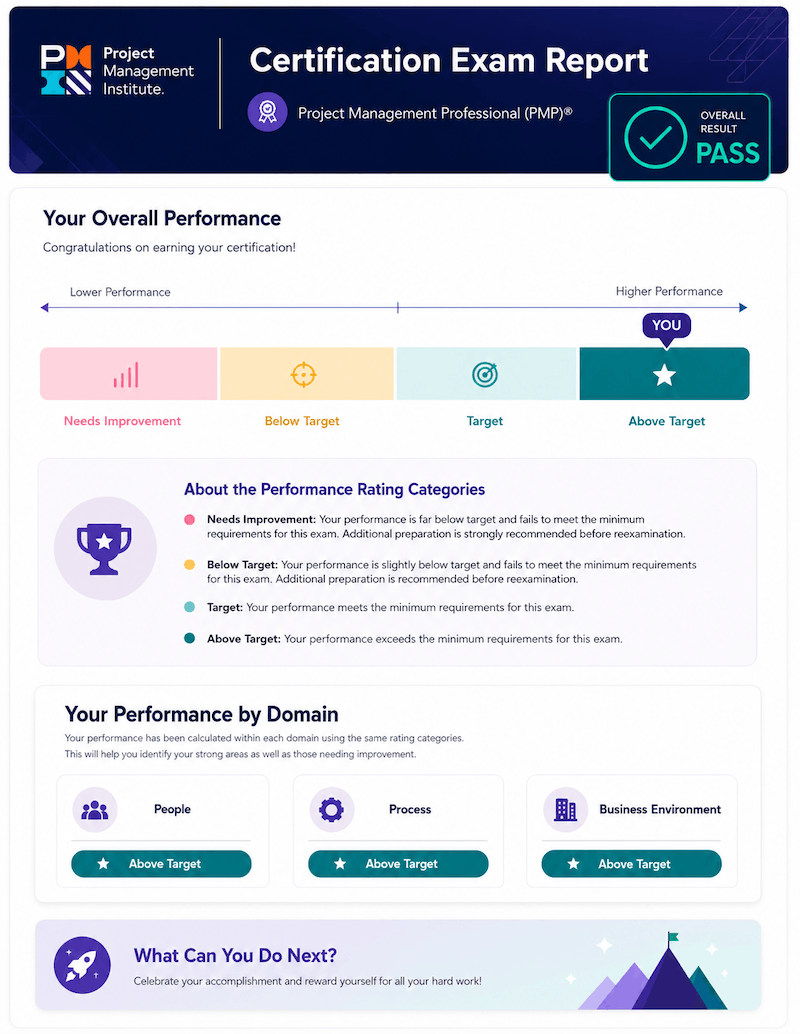
PMI does not disclose the exact number of correct answers required to pass the PMP® exam.
At IMT-PM, based on feedback from thousands of customers who have successfully passed the PMP® exam on their first attempt over the past 15 years, achieving a 70% accuracy rate on mock tests in our eLearning system is considered a strong indicator of exam readiness.
You will receive access to the IMT-PM eLearning system within one business day after enrolling in the training.
3. Glossary of Terms
5 Whys Method
An effective tool for root cause analysis in which the question Why? is asked of a problem in succession until the root cause is found. Developed by Sakichi Toyoda, a Japanese inventor and industrialist, the 5 Whys method is an integral part of the Lean philosophy.
80/20 Rule
A general guideline with many applications; in terms of controlling processes, it contends that a relatively large number of problems or defects, typically 80 percent, are commonly due to a relatively small number of causes, typically 20 percent. This rule is also known as Pareto analysis and the results displayed on a Pareto Chart.
100 Percent Rule
A principle stating that the total of the work at the lowest levels of a work breakdown chart (WBS) rolls up to the higher levels. The 100 percent rule ensures that a WBS captures all known scope and project deliverables.
A/B Testing
A marketing approach used to determine user preferences by showing different sets of users' similar services—an ‘Alpha’ and a ‘Beta’ version—with one independent variable.
Accept
A strategy for managing negative risks or opportunities that involves acknowledging risk and not taking any action until the risk occurs.
Acceptance Criteria
A set of conditions that are met before deliverables are accepted. See also deliverable and requirement.
Accepted Deliverables
Deliverables that meet the acceptance criteria and have been formally signed off and approved by the customer or sponsor as part of the scope validation process.
Active Listening
A communication technique that involves acknowledging the speaker’s message and the recipient clarifying the message to confirm that what was heard matches the message that the sender intended.
Activity
A distinct, scheduled portion of work performed during a project. Activities have a duration, with a beginning and an end. Also known as a schedule activity.
Activity Attributes
Multiple attributes associated with each activity that can be included within the activity list.
Activity Cost Estimates
Each task is assigned a budget, and the aggregate of these estimates results in the project budget. Activity cost estimates include labor, materials, equipment, and fixed cost items like contractors, services, facilities, financing costs, and so on. This information can be presented in detailed or summarized form.
Activity Dependency
A logical relationship that exists between two project activities. The relationship indicates whether the start of an activity is contingent upon an event or input from outside the activity.
Activity Duration Estimates
Quantitative assessments of the likely number of time periods that are required to complete an activity.
Activity List
A documented tabulation of schedule activities that shows the activity description, activity identifier, and a sufficiently detailed scope-of-work description so project team members understand what work is to be performed.
Activity on Arrow or Activity on Node
A graphical diagram on which schedule activities are represented by nodes (rectangular boxes) and their dependencies are depicted by arrows.
Activity Resource Estimates
Material and human resources that are needed to complete an activity; often expressed by a probability or range.
Activity Resource Requirements
The resources (physical, human, and organizational) required to complete the activities in the activity list.
Actual Cost (AC)
Earned value management (EVM) term for the realized cost incurred for the work performed on an activity during a specific time.
Adaptive
A type of project life cycle or methodology that values responding to change over following a set plan. Adaptive methodologies seek solutions that deliver maximum value to the customer.
Administrative Closure
Involves verifying and documenting project results to formalize project or phase completion.
Affinity Diagram
A technique that allows large numbers of ideas to be classified into groups for review and analysis.
Affinity Estimating
A technique designed to rapidly estimate large stories (epics or features) in the backlog. Examples include T-shirt sizes, coffee cup sizes, or a Fibonacci sequence.
Agile
A term used to describe a mindset of values and principles as set forth in the Agile Manifesto.
Agile Coach
A process role on a project team that helps organizations achieve true agility by coaching teams across the enterprise on how to apply agile practices and choose their best way of working.
Agile Estimating
An approach that assists with planning a project appropriately from the beginning to ensure the team can focus on the quality of each deliverable.
Agile Life Cycle
An approach that’s both iterative and incremental to refine work items and deliver frequently.
Agile Manifesto
In 2001, a group of 17 software developers met in Snowbird, Utah to discuss lightweight software development. Based on their experiences, they came up with the four core values of agile software development that make up the Agile Manifesto: individuals and interactions over processes and tools, working software over comprehensive documentation, customer collaboration over contract negotiation, and responding to change over following a plan.
Agile Practitioner
A person embracing the agile mindset who collaborates with like-minded colleagues in cross-functional teams. Also referred to as an agilist.
Agile Modeling
A representation of the workflow of a process or system that the team can review before it is implemented in code.
Agile Principles
A set of 12 guidelines that support the Agile Manifesto and which practitioners and teams should internalize and act upon.
Pursue customer satisfaction by early and continuous delivery of valuable software
Welcome changing requirements, even in late development
Deliver working software frequently (weeks rather than months)
Close, daily cooperation between business and technical people
Projects are built around motivated individuals, who should be trusted
Face-to-face conversation is the best form of communication (colocation)
Working software is the primary measure of progress
Sustainable development, able to maintain a constant pace
Continuous attention to technical excellence and good design
Simplicity is essential
Best architectures, requirements, and designs emerge from self-organizing teams
Regularly, the team reflects on how to become more effective and adjusts accordingly
Agile Release Planning
A process in which a team determines the number of iterations, or sprints, that are needed to complete each release, the features that each iteration will contain, and the target dates of each release.
Agile Space
Team space that encourages colocation, collaboration, communication, transparency, and visibility.
Agreements
Any documents or communications that define the initial intentions of a project. Examples include contracts, memorandums of understanding (MOUs), service-level agreements (SLAs), letters of agreement, letters of intent, verbal agreements, emails, or other written agreements.
Allowable Costs
Costs that are allowed under the terms of the contract. Typically, allowable costs become relevant under certain types of cost-reimbursable contracts in which the buyer reimburses the seller’s allowable costs.
Ambiguity
A state of being unclear, having difficulty in identifying the cause of events, or having multiple options from which to choose.
Analogous Estimation
A technique for estimating the duration or cost of an activity on a project using historical data from a similar activity or project. Also known as top-down estimating.
Analytical Techniques
Logical approach that looks at the relationship between outcomes and the factors that can influence them.
Approved Change Requests
Logical approach that looks at the relationship between outcomes and the factors that can influence them.
Artifact
Any project management processes, inputs, tools, techniques, outputs, EEFs, and OPAs that the project management team uses on their specific project. They are subject to configuration management and are maintained and archived by the team.
Assumption
A factor in the planning process that’s considered true, real, or certain without proof or demonstration. Anything considered true during planning should be validated. Assumptions are closely linked to constraints.
Assumption and Constraint Analysis
A process that explores the validity of the project assumptions within project constraints and identifies risks from any incompleteness or inaccuracy of these project assumptions.
Assumption Log
A list of all uncertainties that are treated as true for the purpose of planning.
Attribute Sampling Data
Data that is counted, such as the number of product defects or customer complaints.
Audit
An examination of a project’s goals and achievements, including adequacy, accuracy, efficiency, effectiveness, and the project’s compliance with applicable methodologies and regulations. It tends to be a formal, one-sided process that can be extremely demoralizing to team members.
Autocratic
A group decision-making method in which one member of the group makes the decision. In most cases, this person will consider the larger group’s ideas and decisions and will then make a decision based on that input.
Avoid
A strategy for managing negative risks or threats that involves changing the project management plan to remove the risk entirely by extending the schedule, changing the strategy, increasing the funding, or reducing the scope.
Backlog
The prioritized list of all the work, presented in story form, for a project team.
Backlog Refinement
The progressive elaboration of project requirements and/or the ongoing activity in which the team collaboratively reviews, updates, and writes requirements to satisfy the need of the customer request.
Backward Pass
Technique for calculating the late start and late finish dates of the schedule activities. This is part of the critical path method and is paired with forward pass to determine activity and schedule float along with the critical path.
Bar Chart
A graphic display of schedule-related information. In a typical bar chart, schedule activities or WBS components are listed down the left side of the chart, dates are shown across the top, and activity durations are shown as date-placed horizontal bars.
Baseline
Original objectives plus approved change requests for scope, schedule, cost, and resources required to finish the project. Baselines represent the approved plan, and they’re useful for measuring how actual results deviate from the plan.
Benchmarking
The comparison of actual or planned products, processes, and practices to those of comparable organizations to identify best practices, generate ideas for improvement, and provide a basis for measuring performance.
Benefits Management Plan
The documented explanation defining the processes for creating, maximizing, and sustaining the benefits provided by a project or program. It also describes how and when the benefits of a project will be derived and measured. Both the business case and the benefits management plan are developed with the benefits owner prior to the project being initiated. Additionally, both documents are referenced after the project has been completed. Therefore, they are considered business documents rather than project documents or components of the project management plan.
Bidder Conferences
The meetings with prospective sellers prior to the preparation of a bid or proposal to ensure all prospective vendors have a clear and common understanding of the procurement. Also called vendor conferences, pre-bid conferences, or contractor conferences.
Bottom-Up Estimating
A method of estimating project duration or cost by aggregating the estimates of the lower-level components of the WBS.
Brainstorming
A simple technique used to generate a list of ideas. It should be led by a facilitator with a group consisting of stakeholders, team members, and subject matter experts. After quickly generating a list of alternatives, the group then performs analysis of the alternatives and generally chooses a particular option for action.
Breach of Contract
The failure to meet some or all the obligations of a contract.
Budget
A time-phased plan for when funds will be disbursed on a project. It helps the organization anticipate when money will be coming in and/or going out for the duration of the project. Budget accuracy is dependent upon a well-defined project scope and schedule. The total project budget is the cost baseline plus management reserves.
Budget at Completion (BAC)
The sum of all budgets established to provide financial support for the work to be performed.
Buffer
A planning term related to contingency.
Burn Chart
A tool used to track the progress of a project by plotting the number of days of sprint against the number of hours of work remaining. The burn chart is used to communicate progress during and at the end of an iteration/sprint/increment, showing the number of stores that have been completed and the ones that remain. The concept is that as the project progresses over time, the backlog of work will burn down, or lessen.
Burn Rate
The rate at which the project consumes financial resources, representing negative cash flow. Burn rates are often used by agile projects to budget costs for planned iterations/sprints/increments.
Burndown Chart
A graphical representation of the work remaining versus the time left in a timebox. A type of burn chart.
Burnup Chart
A graphical representation of the work completed toward the release of a product. A type of burn chart.
Business Case
A value proposition for a proposed project that may include financial and nonfinancial benefits.
Business Document
An artifact developed prior to the project, used as part of the business case, and which is reviewed periodically by a project professional to verify benefit delivery.
Business Requirement
A requirement that describes a higher-level need of the organization, such as a business issue or opportunity, the rationale for why an initiative is being undertaken, and a measurable representation of a goal the business is seeking to achieve.
Business Requirement Documents (BRD)
Listing of all requirements for a specific project.
Business Risk
The inherent risk in any business endeavor that carries the potential for either profit or loss. Types of business risks are competitive, legislative, monetary, and operational.
Business Value
The net quantifiable benefit derived from a business endeavor. The benefit may be tangible, intangible, or both.
Cadence
A rhythm of project work execution.
Capability Maturity Model Information (CMMI)
The CMMI provides a framework for the integration of process improvement for multiple process areas. Associated with quality management.
Cause and Effect Diagram
This diagram shows the relationship between causes and effects. Primarily used in root cause analysis (risk and quality) to uncover the causes of risks, problems, or issues. Also called a fishbone diagram or Ishikawa diagram.
Cease and Desist Letter
A legal document sent to an individual or a business with the direct intention of stopping specific activities and preventing their occurrence or recurrence.
Change Control
Purposeful management of changes to the project (scope, schedule, cost, or quality). In change control, a change request goes through a formal process before an approval or denial is made.
Change Control Board (CCB)
A formally chartered group responsible for reviewing, evaluating, approving, delaying, or rejecting changes to the project and for recording and communicating such decisions.
Following a CCB meeting, decisions are recorded and communicated to the appropriate stakeholders. A CCB meeting may also be referred to as a change control meeting.
Change Control Form
A document used to request a project change, including recommendations for corrective or preventive actions.
Change Control System
A set of procedures that describes how modifications to the project deliverables and documentation are managed and controlled.
Change Log
A living list of all project change requests (CR). This log is used to track and provide accurate status of each CR (requester, owner, details, impact analysis, decision, and so on).
Change Management
A comprehensive, cyclic, and structured approach for transitioning individuals, groups, and organizations from a current state to a future state, where they realize desired benefits. Change management is different than project change control, which is a process whereby modifications to documents, deliverables, or baselines associated with the project are identified, documented, and then approved or rejected.
Change Management Plan
A component of the project management plan that establishes the Change Control Board, documents the extent of its authority, and describes how the change control system will be implemented.
Change Request (CR)
A request for change sent to upper management or the change control board (CCB) for its evaluation and approval.
Charter
A shortened name for the project charter, a formal document that starts the project. Typically used by the project sponsor and the project manager, this document provides the reason for the project (based on business case) and may include high-level requirements, assumptions, constraints, milestone(s), and a preliminary budget.
Checklist
A set of procedural instructions used to ensure that a product or component quality is achieved.
Checklist Analysis
A technique for systematically reviewing materials using a list for accuracy and completeness.
Claim
An issue with the contract brought by one party against another. Claims must be resolved before the contract can be properly closed out.
Close Project or Phase Process
The process of finalizing all activities for the project, phase, or contract.
Close-Out Meetings
Sessions held at the end of a project or phase during which teams discuss work and capture lessons learned.
Coach
An agile servant leader role that exists to help the team and identify and remove any impediments (obstacles).
Coaching
The act of giving guidance and direction to another person to facilitate personal and/or professional growth and development.
Code of Accounts
A numbering system used to uniquely identify each component of the WBS.
Code of Ethics and Professional Conduct
A PMI®-published body of knowledge that describes the ethical, professional behavior and expectations of an individual working as a project practitioner or with PMI in a given capacity.
Collaboration
The act of working together and sharing information to create deliverables, work products, or results.
Collect Requirements Process
The process in which requirements documentation is developed. Precedes the Define Scope process.
Colocation
An organizational placement strategy in which project team members are physically located close to one another to improve communication, working relationships, and productivity.
Common Cause
A reason contributing to a quality problem that is usually considered acceptable. Common causes are considered unpreventable or if they are preventable, the cost of prevention would not justify the benefit.
Communication
The act of accurately encoding, sending, receiving, decoding, and verifying messages. Communication between sender and receiver may be oral or written, formal or informal.
Communication Channels
The number of possible communication paths on a project. The formula for calculating communication channels is [n(n - 1)] ÷ 2; n = number of people on the project.
Communication Method
A systematic procedure, technique, or process used to transfer information among project stakeholders.
Communication Model
A description, analogy, or schematic used to represent how the communication process will be performed for the project.
Communication Requirements Analysis
An analytical technique used to determine the information needs of project stakeholders through interviews, workshops, or a study of lessons learned from previous projects.
Communication Styles Assessment
A technique to identify the preferred communication method, format, and content for stakeholders for planned communication activities.
Communication Technology
Specific tools, automated systems, computer programs, and so on used to transfer information among project stakeholders.
Communications Management Plan
A component of the project, program, or portfolio management plan that describes how, when, and by whom information about the project will be administered and disseminated.
Community of Practice (CoP)
As described by E. Wenger in his book, Cultivating Communities of Practice, the CoP uses an idea inspired by the Shell Oil Corporation’s offshore drilling teams to establish local forums of experts with the specific mandate of creating an arena in which project managers can feel comfortable sharing their findings and learnings from their projects.
Completion Contract
A type of contract that is completed when the vendor delivers the product to the buyer and the buyer accepts the product.
Complexity
A characteristic of a program, project, or its environment that’s difficult to manage due to human behavior, system behavior, or ambiguity.
Compliance
The state of meeting—or being in accord with—organizational, legal, certification, or other relevant regulations.
Compromise
An option in conflict management in which both parties give up something to reach an agreement.
Conduct Procurement Process
The process of obtaining seller responses, selecting a seller, and awarding a contract.
Cone of Uncertainty
Agile term describing the difficulty of estimating early due to unknowns and how that should improve over time.
Configuration Item
Any component or project element that needs to be managed to ensure the successful delivery of the project, services, or result.
Configuration Management
A tool used to manage changes to a product or service being produced as well as changes to any of the project documents—for example, schedule updates.
Configuration Management Plan
A component of the project management plan that describes how to identify and account for project artifacts under configuration control and how to record and report changes to them.
Configuration Management System
A collection of procedures used to track project artifacts and monitor and control changes to these artifacts.
Conflict
A difference in opinion or agenda among team members, stakeholders, or customers on a project.
Conflict Management
The application of one or more strategies for dealing with disagreements that may be detrimental to team performance.
Conflict Resolution
The process of working to reach an agreement after a conflict arises.
Consensus
A group-decision technique in which the group agrees to support an outcome even if some individuals don’t agree with the decision.
Constraint
An external factor that limits the ability to plan. Constraints and assumptions are closely linked.
Context Diagram
A visual depiction of the product scope showing a business system (process, equipment, computer system, and so on) and how people and other systems (actors) interact with it.
Contingency Plan
A risk-response strategy developed before risks occur; it’s meant to be used if and when identified risks become reality.
Contingency Reserve
Time or money allocated in the schedule or cost baseline for known risks with active response strategies.
Contingency Theory
A theory credited to Fred. E. Fielder which states that the set of skills and attributes that helped a project manager in one environment may work against them in another environment.
Continuous Flow
Refers to the continuous movement of work through a process. It is based on the principles of Lean and is designed to help teams reduce waste and improve efficiency. In a continuous flow system, work is broken down into small, manageable pieces and continuously moved through the process. This helps to reduce the amount of time that work spends waiting in queues and helps to ensure that work is always moving forward.
One example of a continuous flow system is the Kanban Method.
Continuous Improvement (CI)
The ongoing effort to improve products, services, or processes.
Continuous Integration
The practice of regularly merging all software code into a shared environment, several times a day, to check code quality and functionality.
Continuous Process Improvement
The systematic, ongoing effort to improve products, services, or processes in an organization.
Contract
A mutually binding agreement that obligates the seller to provide the specified project, service, or result and obligates the buyer to pay for it.
Contract Change Control System
The system used to collect, track, adjudicate, and communicate changes to a contract.
Control Account
A management control point at which scope, budget, actual cost, and schedule are integrated and compared to earned value for performance measurement.
Control Charts
A graphic display of process data over time and against established control limits; the display has a centerline that assists in detecting a trend of plotted values toward either control limit. Control charts are often associated with control limits, specification limits, means, and standard deviation. They’re used to analyze and communicate the variability of a process or project activity over time.
Controlling PMO
A type of PMO that provides support and requires compliance through various means. Compliance may involve adopting project management frameworks or methodologies; using specific templates, forms, and tools; or conformance to governance.
Corrective Action
Steps (action) to bring future results in line with the plan; this can change the plan or the way the plan is being executed.
Cost Aggregation
Summing the lower-level cost estimates associated with the various work packages for a given level within the project’s WBS or for a given cost control account.
Cost Baseline
The approved version of the time-phased project budget—excluding any management reserves—which can be changed only through formal change control procedures and is used as a basis for comparison to actual results.
Cost-Benefit Analysis
A financial analysis method used to determine the benefits of a project against its costs.
Cost-Benefit Ratio (BCR)
The ratio of the expected benefits and the anticipated costs.
Cost Forecast
Cost estimates adjusted according to performance—for example, estimate at complete, budget at completion, estimate to complete, and so on.
Cost Management Plan
A component of a project or program management plan that describes how costs will be planned, structured, and controlled.
Cost of Conformance
Cost of conformance refers to the costs associated with preventing poor quality in products, deliverables, or services of a specific project. This includes the following:
Appraisal costs: Costs related to evaluating, measuring, auditing, and testing products, deliverables, or services of a specific project.
Prevention costs: Costs related to building a quality product, including training, documenting processes, equipment, and time to do it right.
Failure costs (internal/external): Costs related to nonconformance of products, deliverables, or services based on the needs or expectations of the stakeholders. This includes rework and scrap.
Cost of Nonconformance
Cost of nonconformance refers to the costs associated with failures found during and after the project due to poor quality in products, deliverables, or services. This includes the following:
- Internal failure costs: Costs related to failures found by the project team, such as rework and scrap.
- External failure costs: Costs related to failures found by the customer, such as liabilities, warranty work, and lost business.
- The cost of nonconformance is a part of the cost of quality, which also includes the cost of conformance. The cost of conformance includes prevention and appraisal costs, while the cost of nonconformance includes waste and rework. Measuring the cost of quality is important for minimizing quality losses and achieving optimal quality costs for projects.
Cost of Quality (CoQ)
All costs incurred over the life of the product by investment in preventing nonconformance to requirements, appraisal of the product or service for conformance to requirements, and failure
to meet requirements.
Cost Performance Index (CPI)
A measure of the cost efficiency of budgeted resources, expressed as the ratio of earned value to actual cost.
Cost Plus Award Fee (CPAF) contract
A category of contract that involves payments to the seller for all legitimate actual costs incurred for completed work, plus an award fee representing seller profit.
Cost Plus Fixed Fee (CPFF) contract
A type of cost-reimbursable contract in which the buyer reimburses the seller for the seller’s allowable costs (allowable costs are defined by the contract) plus a fixed amount of profit (fee).
Cost Plus Incentive Fee (CPIF) contract
A type of cost-reimbursable contract in which the buyer reimburses the seller for the seller’s allowable costs (allowable costs are defined by the contract), and the seller earns a profit if they meet defined performance criteria.
Cost Variance (CV)
The amount of budget deficit or surplus at a given point in time, expressed as the difference between the earned value and the actual cost.
Cost-Benefit Analysis
A cost-benefit analysis allows project managers to compare if the benefits of an action outweigh the costs or, conversely, if the costs outweigh the benefits. This can be an important criterion in decision making.
Cost-Reimbursable Contract
A type of contract involving payment to the seller for the seller’s actual costs, plus a fee typically representing the seller’s profit.
Crashing
Applying additional resources to one or more tasks or activities to complete the work more quickly. Crashing usually increases costs more than risks. In comparison, fast-tracking increases risks.
Create WBS Process
A planning process that produces the schedule baseline, which consists of the work breakdown structure (WBS), the WBS dictionary, and the scope statement. (The scope statement is produced from the Define Scope process.)
Critical Path
The sequence of activities that represents the longest path through a project, which determines the shortest possible duration.
Critical Path Activity
Any activity on the critical path in a project schedule.
Critical Path Method (CPM)
A technique of schedule analysis in which schedule activities are evaluated to determine the float or slack for each activity and the overall schedule. To calculate critical path, use the forward and backward pass along with float analysis to identify all network paths, including critical.
Critical Thinking
Critical thinking includes disciplined, rational, logical, evidence-based thinking and requires an open mind and the ability to analyze objectively. Critical thinking, especially when applied to discovery, can include conceptual imagination, insight, and intuition. It can also include reflective thinking and metacognition (thinking about thinking and being aware of one’s awareness).
Project professionals need to recognize bias, identify the root cause of problems, and consider challenging issues, such as ambiguity, complexity, and so forth. Critical thinking helps to accomplish these activities.
Project team members apply critical thinking to:
Research and gather unbiased, well-balanced information;
Recognize, analyze, and resolve problems;
Identify bias, unstated assumptions, and values;
Discern the use of language and the influence on oneself and others;
Analyze data and evidence to evaluate arguments and perspectives;
Observe events to identify patterns and relationships;
Apply inductive, deductive, and abductive reasoning appropriately; and
Identify and articulate false premises, false analogy, emotional appeals, and other faulty logic.
Cross-Functional Teams
Teams that have all the capabilities to deliver the work they’re assigned. Team members can specialize in certain skills, but the team can deliver what they’ve been called on to build.
Crystal Family of Methodologies
A collection of lightweight, agile software-development methods focused on adaptability to a particular circumstance.
Cultural Awareness
Understanding the cultural differences of the individuals, groups, and organizations in the project stakeholder community to adapt communication strategies that avoid or reduce miscommunication and misunderstandings.
Customer
The individual or organization that will accept the deliverable(s) or product. Customers can be internal organizational groups or external to an organization.
Cycle Time
Refers to the period from the time a team starts a task to the time it’s completed.
Daily Coordination Meeting
See Daily Standup
Daily Standup
A brief—typically 15-minute—collaboration meeting during which the project team reviews its progress from the previous day, declares intentions for the current day, and highlights any obstacles encountered or anticipated. This meeting may also be referred to as a daily scrum or standup.
Data
Refers to gathered empirical information, especially facts and numbers.
Data Analysis
The act of scrutinizing facts and numbers for typical purposes of decision-making, verifying, validating, or assessing.
Data Gathering
Techniques used to solicit and document ideas—for example, brainstorming, interviews, focus groups, questionnaires, surveys, and so on.
Data Representation
A way of depicting data visually to aid in its communication and comprehension.
De Facto Regulations
Regulations that are widely accepted and adopted through use.
De Jure Regulations
Regulations that are mandated by law or have been approved by a recognized body ofexperts.
Debriefing
An informal, collaborative means of discussing the positives and the negatives of a project, what worked, and what will be done differently next time. This discussion includes technology issues, people issues, vendor relationships, and organizational culture.
Decision-Making
The process of selecting a course of action from among multiple options.
Decision Tree Analysis
A diagramming and calculating technique for evaluating the implications of a chain of multiple options in the presence of uncertainty.
Decomposition
A technique used for dividing and subdividing the project scope and project deliverables into smaller, more manageable parts.
DEEP
An acronym used in agile projects that describes desirable attributes of a product backlog. Stands for: Detailed, Estimable, Emergent and Prioritize.
Definition of Done (DoD)
A team’s checklist of all the criteria required to be met so that a deliverable can be considered ready for customer use.
Definition of Ready (DoR)
A team’s checklist for a user-centric requirement that has all the information the team needs to begin working on it.
Deliverable
Any unique and verifiable product, result, or capability that’s used to perform a service and is required to be produced to complete a process, phase, or projects.
Delphi Technique
A form of gathering expert opinions in which members of a group are asked or polled anonymously.
Demo
A review at the end of each iteration with the product owner and other customer stakeholders to review the progress of the product, get early feedback, and review an acceptance from the product owner of the stories delivered in the iteration.
Dependency
A relationship between one or more tasks/activities. A dependency may be mandatory or discretionary, internal or external.
Design for X (DfX)
A set of technical guidelines that may be applied during the design of a product for the optimization of a specific aspect of the design. DfX can control or even improve the product’s final characteristics.
Design of Experiments (DoE)
A data analysis technique—typically used with multiple variables—to determine the optimal condition
DevOps
A collection of practices for creating a smooth flow of delivery by improving collaboration between development and operations staff.
Diagramming Techniques
Various means of depicting a system or virtual concept, such as a business or process flow, that indicate entities, relationships, and interactions.
Dictatorship
A group decision technique in which one person makes the decision for the entire group.
Direct and Manage Project Work Process
An Executing process that reviews the entire project and analyzes planned versus actual (with schedule forecast and cost forecast as an input) to determine the overall project status.
Direct Cost
A cost that is reported against the project, which may include salaries for human resources, materials, and other expenses. It does not include shared expenses or overhead expenses.
Directions of Influence
A classification model that groups stakeholders based on how they influence the project and/or the project team: upwards (senior management); downwards (team or specialists); outwards (external); or sidewards (project manager’s peers).
Directive PMO
A type of PMO that takes control of projects by directly managing projects.
Disaggregation
Breaking down epics or large stories into smaller stories. This is similar to decomposition on predictive projects.
Discretionary Dependency
A relationship that is established based on knowledge of best practices within a particular application area or an aspect of the project in which a specific sequence is desired.
Document Analysis
A technique used to gain project requirements from current document valuation.
Duration
Amount of time needed to complete an activity/task or work package.
Early Finish
Used in a networking diagram, this represents the earliest date that the activity can finish.
Early Start
Used in a networking diagram, this represents the earliest date that the activity can start.
Earned Value (EV)
A measure of work performed expressed in terms of the budget authorized for that work.
Earned Value Analysis (EVA)
An analysis method that uses a set of measures associated with scope, schedule, and cost to determine the cost and schedule performance of a project.
Earned Value Management (EVM)
A methodology that combines scope, schedule, and resource measurements to assess project performance and progress.
EEF
Any or all environmental factors, either internal or external to the project, that can influence the project's success. Enterprise environmental factors (EEFs) include culture, weather conditions, government regulations, political situations, market conditions, and so on.
Effect-Based Risk Classification
A way of analyzing the major risks inherent to a project that could have an impact on its success. These major risks include time, cost, quality, and scope.
Effort
The number of labor units required to complete a scheduled activity or WBS component, often expressed in hours, days, or weeks.
Elapsed Time
The actual calendar time required for an activity from start to finish.
Emotional Intelligence (EI)
The ability to identify, assess, and manage the personal emotions of oneself and other people, as well as the collective emotions of groups of people. EQ (emotional quotient) is also a commonly used abbreviation.
Empathy
Part of emotional intelligence (EQ or EI), this is the ability to understand others’ viewpoints and be a team player. It enables us to connect with others and understand what moves them.
Empowerment
An essential attribute of agile teams to enable localized decision-making capabilities. Empowerment is the quality of granting, nurturing, or motivating a team member or team to exercise their own knowledge, skill, and ability.
Engagement Roadmap
Another name for stakeholder engagement roadmap—a guideline based on the stakeholder analysis that sets forth processes for engaging with stakeholders at current and all future states of the project.
Enhance
A strategy for managing positive risks or opportunities that involves increasing the probability that the opportunity—or the impact it will have—will happen by identifying and maximizing enablers of these opportunities.
Epic
A block of work with one common objective, such as a feature, customer request or business requirement. A helpful way to organize work and create a hierarchy, an epic helps teams break their work down, while continuing to work towards a bigger goal.
Escalate
The act of seeking helpful intervention in response to a threat outside the scope of the project or beyond the project manager’s authority.
Estimate
A number, figure, or representation that denotes cost or time.
Estimate Activity Durations Process
A planning process that determines the estimate time needed to complete a work package and/or activity.
Estimate at Completion (EAC)
The expected total cost of completing all work, expressed as the sum of the actual cost to date and the estimate to complete.
Estimate to Complete (ETC)
The expected cost of finishing all the remaining project work.
Exit Gate
Logical point at the end of a project phase at which an independent party and/or relevant stakeholder reviews that phase’s deliverables to determine whether they were completed successfully and whether the subsequent project phase should be initiated. Used in predictive or traditional projects.
Expectancy Theory
Motivational theory which proposes that the team makes choices based on the expected outcome.
Expected Monetary Value (EMV)
A quantitative method of calculating the average outcome when the future is uncertain. The calculation of EMV is a component of decision tree analysis. Opportunities will have positive values, and threats will have negative values.
Expert Judgment
Judgment based upon expertise in a given application area, knowledge area, discipline, or industry. Such expertise may be provided by any group or person with specialized education, knowledge, skill, experience, or training.
Explicit Knowledge
Knowledge that can be codified using symbols such as words, numbers, and pictures. This type of knowledge is easily documented and may be shared with others.
Exploit
A strategy for managing positive risks or opportunities that involves attempting to make sure that the opportunity happens.
External Dependency
Types of activity dependencies that exist between project activities and other, non-project activities and can be out of the project’s control.
Extreme Programming (XP)
Agile methodology used for software development in which iterations last for one week and programmers work in pairs.
Facilitated Workshops
Organized working sessions held by project managers to determine a project’s requirements and to get all stakeholders together to agree on the project’s outcomes.
Facilitation
A skill used to lead or guide an assembled group toward a successful conclusion such as making a decision or finding a solution.
Fast Tracking
A schedule compression technique in which activities or phases normally done in sequence are performed in parallel for at least a portion of their duration.
Feature
A group of stories that delivers value to the customer.
Fibonacci Sequence
A mathematical sequence in which the value of each number is derived from the sum of the two preceding numbers (0, 1, 1, 2, 3, 5, 8, 13, 21, 34, 55, 89, 144 ... ). Used in agile estimating or relative estimating techniques, such as planning poker. Simplified sequence: 0, 1, 2, 3, 5, 8, 13, 20, 40, 100.
Final Report
A summary of the project’s information regarding performance, scope, schedule, quality, cost, and risks.
Finish-to-Finish (FF)
A logical relationship in which a successor activity can’t finish until a predecessor activity has finished.
Finish-to-Start (FS)
A logical relationship in which a successor activity can’t start until a predecessor activity has finished.
Firm Fixed Price Contract (FFP)
A type of fixed price contract in which the buyer pays the seller a set amount (as defined by the contract), regardless of the seller’s costs.
Fishbone Diagram
See Cause and Effect Diagram.
Fixed Price Contract
An agreement that sets the fee that will be paid for a defined scope of work regardless of the cost or effort to deliver it.
Fixed Price Incentive Fee (FPIF) contract
A type of contract in which the buyer pays the seller a set amount (as defined by the contract), and the seller can earn an additional amount if the seller meets defined performance criteria.
Fixed Price with Economic Price Adjustment (FPEPA) contract
A fixed-price contract, but with a special provision allowing for pre-defined final adjustments to the contract price due to changed conditions, such as inflation changes, or cost increases (or decreases) for specific commodities.
Float
Also called slack.
Flow-Based Agile
An agile methodology that focuses on optimizing the flow of work through the development process. It is based on the principles of Lean and Kanban and is designed to help teams improve their efficiency and productivity.
Focus Groups
An elicitation technique that brings together prequalified stakeholders and subject matter experts to learn about their expectations and attitudes about a proposed product, service, or result.
Forward Pass
Technique for calculating the early start and early finish dates of the schedule activities. This is part of the critical path method and is paired with backward pass to determine activity and schedule float along with the critical path.
Free Float
The amount of time that a schedule activity can be delayed without delaying the early start date of any successor or violating a schedule constraint.
Functional Manager
A supervisory, organizational role in a specialized area or department.
Functional Organization
An organizational structure in which staff are grouped by specialization areas and the project manager has limited authority to assign work and apply resources.
Functionality
In an agile context, an action that the system performs that adds value to the customer/user.
Funding Limit Reconciliation
The process of comparing the planned expenditure of project funds against any limits on the commitment of funds for the project to identify any variances between the funding limits and the planned expenditures.
Gantt Chart
A bar chart of schedule information on which activities are listed on the vertical axis, dates are shown on the horizontal axis, and the activity durations are shown as horizontal bars placed according to start and finish dates.
Generalizing Specialist
Refers to a project team member who has a particular area of deep expertise but also has experience in many other areas that may not be directly related to their core area. These team members are valuable during agile projects because of their ability to work in different areas.
Gold Plating
Adding more scope than the customer requested and/or that the team planned for.
Grooming
Cleaning up the backlog through various activities such as removing, reprioritizing, disaggregating, or estimating.
Group Decision Techniques
Teamworking techniques to move a group towards consensus or decision. Examples are unanimity, majority, plurality, and dictatorship.
Growth Mindset
As conceived by Stanford psychologist Carol Dweck and her colleagues, this is the belief that a person's capacities and talents can be improved over time.
Ground Rules
Expectations regarding acceptable behavior by project team members.
Hardening Iteration/Iteration H
Specialized increment/iteration/sprint dedicated to stabilizing the code base so that it is robust enough for release. No new functionality is added. Primarily used for refactoring and/or technical debt.
Herzberg’s Motivation-Hygiene Theory
In 1959, behavioral scientist Frederick Herzberg proposed that “hygiene,” or environmental factors, can cause workers to feel satisfied or unsatisfied with their jobs, and these factors affect their performance. The theory also proposes that a worker’s independent drive associated with motivation also affects performance, and that workers respond to feelings of connection with their work. Therefore, leaders should encourage workers to accept more authority as well as promote feedback. Also known as Two-Factor Theory, Herzberg’s Motivation Theory, and Dual Structure Theory.
Histogram
A bar or column chart that graphically represents numerical data—for example, the number of defects per deliverable, a ranking of the cause of defects, the number of times each process is noncompliant, or other representations of project or product defects.
Historical Information
Archived information from previous projects that can be used for various reasons, including estimating cost, schedule, resources, and lessons learned.
Ideal Time
An estimation technique that refers to the time it would take to complete a given task assuming neither interruptions nor unplanned problems arise.
Identify Risks
Performed throughout the project, this is the process of identifying individual project risks as well as sources of overall project risk and documenting their characteristics. The key benefit of this process is the documentation of existing individual project risks and the sources of overall project risk. The process also brings together information so the project team can respond appropriately to identified risks.
Identify Stakeholders
Performed periodically throughout the project as needed, this is the process of identifying project stakeholders regularly and analyzing and documenting relevant information regarding their interests, involvement, interdependencies, influence, and potential impact on project success. The key benefit of this process is that it enables the project team to identify the appropriate focus for engagement of each stakeholder or group of stakeholders.
Impediment
An obstacle that prevents the team from achieving its objectives.
Increment
A functional, tested, and accepted deliverable that’s a subset of the overall project outcome.
Incremental Delivery
An agile concept that functionality should be delivered in small pieces or stages rather than as a complete solution.
Incremental Life Cycle
An adaptive project life cycle in which the deliverable is produced through a series of iterations that successively add functionality within a predetermined timeframe. After the final iteration, the deliverable contains the necessary and sufficient capability to be considered complete.
Independent Estimates
Estimates generated by experts outside the project for the purposes of comparing them with those made by the team.
Indirect Costs
A cost usually tracked as part of a contract, that is not expended directly for the project’s benefit.
Influence Diagram
Used in quality management decisions. A graphical representation of situations showing causal influences, time ordering of events, and other relationships among variables and outcomes.
Influence/Impact Grid
Used in stakeholder management. A classification model that groups stakeholders on the basis of their involvement in and impact on the project.
Influencing
The act of presenting a good case to explain why an idea, decision, or problem should be handled a certain way, without resistance from other individuals.
Information
Data that has been analyzed, organized, and processed to make it more meaningful.
Information Management
A system that allows the team to collaborate, share, and capture project work.
Information Management System
A way to collect, manage, and distribute project information.
Information Radiator
The generic term for visual displays placed in a visible location so everyone can quickly see the latest information. Also known as Big Visible Chart in agile.
Input
Something needed or used by a process to create the process output.
Inspection
Reviewing the functionality or suitability of a product, service, or result against the plan (requirements/story).
Insurable Risk
A risk that has only the potential for loss and no potential for profit or gain. An insurable risk is one for which insurance may be purchased to reduce or offset the possible loss. Types of insurable risks are direct property, indirect property, liability, and personnel related.
Interactions
In an agile context, this generally refers to face-to-face conversations between members, customers, and stakeholders.
Interactive Communication
An exchange of information between two or more individuals that ensures common understanding for everyone participating in that exchange.
Internal Dependency
A type of activity dependency that exists between project activities and is usually under the project’s control.
Internal Rate of Return (IRR)
The interest rate that makes the net present value of all cash flow equal to zero. This rate is a function of the cost of capital for project implementation.
Interpersonal Skills
Skills used to establish and maintain relationships with other people or stakeholders.
Interview
A formal or informal approach to elicit information from stakeholders by talking with them directly.
INVEST
Acronym describing the desirable attributes of a good story. Stands for: Independent, Negotiable, Valuable, Estimable, Small, and Testable.
Invitation for Bid (IFB)
A type of procurement document most commonly used when deliverables are commodities for which there are clear specifications and when quantities are very large. The invitation is usually advertised, and any seller may submit a bid. Negotiation is typically not anticipated. These are sometimes used interchangeably with RFPs. Generally, this term is equivalent to RFP. However, in some application areas, it may be a narrower or more specific meaning.
Ishikawa Diagram
See Cause and Effect Diagram.
Issue
A current condition or situation that may have an impact on the project objectives.
Issue Log
Used to record and monitor information on active issues. Issues are assigned to a responsible party for follow-up and resolution.
Iteration
A timeboxed cycle of development on a product or deliverable in which all the work needed to deliver value is performed.
Iteration Backlog
The work committed to during a given iteration and that’s expected to burn down the duration. This work doesn’t carry over to the next iteration.
Iterative Life Cycle
A project life cycle in which the project scope is generally determined early in the project life cycle, but time and cost estimates are routinely modified as the project team’s understanding of the product/service increases. Iterations progressively develop the product/service through a series of repeated cycles, while increments successively add to the functionality of the product/service.
Iteration Planning
An iteration planning meeting is used to clarify the details of backlog items, acceptance criteria, and the work effort required to meet an upcoming iteration commitment. This meeting may also be referred to as a sprint planning meeting.
Iteration Review
An iteration review is held at the end of an iteration to demonstrate the work that was accomplished during the iteration. This meeting may also be referred to as a
sprint review.
Job Shadowing
Techniques used to gain knowledge of a specific job role, task, or function to understand and determine project requirements.
Joint Application Design (JAD)
Specialized workshops that include both SMEs and the development team together to discuss and improve on the software development process.
Kaizen
A management concept adapted by the project management community that refers to project activities that continuously improve all project processes. Kaizen usually involves all stakeholders; the concept originated in Japan and generally involves “change for the better” or “continuous improvement.”
Kanban
Japanese management philosophy that means “signal.” This philosophy focuses on promoting visibility of the work in process (WIP) and limiting the amount of WIP that the team allows.
Kanban Board
A visualization tool that enables improvements to the flow of work by making bottlenecks and work quantities visible. It’s a popular framework, used to implement agile and DevOps software development. Also referred to as a signboard.
Kano Model
A mechanism, derived from the customer marketing industry, to understand and classify all potential customer requirements or features into four categories.
Key Performance Indicator (KPI)
A set metric used to evaluate a project, an organizational unit, or a project team’s performance against the project vision and objectives. KPI can be time bound.
Kickoff
A kickoff meeting is a gathering of project team members and other key stakeholders at the outset of a project to formally set expectations, gain a common understanding, and commence work. It establishes the start of a project, phase, or iteration.
Kill Point
The stage gate or phase review point. At this point, the progress of the project is evaluated, and a decision is made to continue or cancel the project. A set of criteria may be developed to assist with the decision.
Knowledge Management
A business area dedicated to connecting individuals to shared knowledge and general collaboration on project work. The modality used for connection can be face-to-face and/or virtual.
Lag
Refers to the amount of time whereby a successor activity will be delayed with respect to a preceding activity on the critical path.
Late Finish
The latest date an activity can finish, without delaying the finish of the project.
Late Start
The latest that a project activity can start without having to reschedule the calculated early finish of the project.
Lead
The amount of time whereby a successor activity can be advanced with respect to predecessor activity.
Leadership
The ability to guide others to achieve results. Leadership abilities are gained through experience, building relationships, and taking on initiatives.
Leading
The act of establishing direction, aligning the team to a vision, and inspiring/motivating them to achieve a project’s objectives.
Lead Time
Refers to the period from the time the team places a task on the board until delivery. Because the order of the items in the Ready column can be changed, this can be unpredictable.
Lean
An agile method used primarily in manufacturing that focuses on achieving outcomes with little or no waste.
Lean Six Sigma
A collaborative team method that provides an enhanced ability to target customer needs and measure performance during project execution and monitoring. It was introduced by American engineer Bill Smith while working at Motorola in 1986.
Legitimate Power
The authority granted to an individual due to his/her position within a group or an organization.
Lessons Learned
The knowledge gained during a project that shows how project events were addressed or should be addressed in the future for the purpose of improving performance.
Lessons Learned Register
A project document used to record knowledge gained during a project. The knowledge attained can be used in the current project and entered into the lessons learned repository for subsequent use.
Lessons Learned Repository
A central store of historical lessons learned information from various projects across jurisdictions.
Life Cycle Costing (LCC)
Life cycle costing is an approach that assesses the total cost of an asset over its life cycle including but not limited to initial capital costs, maintenance costs, etc. LCC is an important economic analysis used in the selection of alternatives that impact both pending and future costs. The concept is also known as lifetime cost and is commonly referred to as cradle-to-grave or womb-to-tomb costs.
Logical Relationship
Those relations between the elements of discourse or thought that constitute its rationality, in the sense either of reasonableness or intelligibility.
Majority
A group decision-making method in which a course of action is agreed upon by a predefined quorum.
Make-or-Buy Analysis
The process of gathering and organizing data about product/service requirements and analyzing data against available alternatives including the purchase or internal manufacture of the project.
Make-or-Buy Decisions
Decisions made regarding the external purchase versus internal manufacture of a product.
Manage Communications
The process of creating, collecting, distributing, storing, retrieving, and the ultimate disposition of project information in accordance with the communications management plan defined within the project.
Manage Project Knowledge
The process of using existing knowledge and creating new knowledge to achieve project objectives and contribute to organizational learning. The process must include tools that allow the conversion of data into information and information into knowledge.
Manage Project Quality
The process of continually measuring the quality of all activities and taking corrective action until the desired quality is achieved. Quality management lowers the risk of product/service failure or unsatisfied clients.
Manage Project Team
The process of tracking team member performance, providing feedback, resolving issues, and managing team changes to optimize project performance. The key benefits of this process are that it influences team behavior, manages conflict, resolves issues, and appraises team member performance.
Manage Stakeholder Engagement Process
The process of communicating and working with stakeholders to meet their needs/expectations, address issues as they occur, and foster appropriate stakeholder engagement in project activities throughout the project life cycle.
Management Reserve
An amount of the project budget held outside of the performance measurement baseline (PMB) for management control purposes, reserved for unforeseen work that’s within the scope of the project. The management reserve, usually 5 to 10% of the project budget, shouldn’t be confused with the contingency reserve.
Managing
The exercise of executive control or authority.
Mandatory Dependency
A relationship that is contractually required or inherent in the nature of the work.
Market Research
The process of evaluating the feasibility of a new product or service through research conducted directly with potential consumers.
Maslow’s Hierarchy of Needs
A theory of psychology explaining human motivation based on the pursuit of different levels of needs. The theory states that humans are motivated to fulfill their needs in a hierarchical order. This order begins with the most basic needs before moving on to more advanced needs. The goal, according to this theory, is to reach the fifth level of the hierarchy: self-actualization.
Matrix Organization
An organizational structure in which the project manager shares responsibility with the functional managers for assigning priorities and for directing the work of individuals assigned to the project.
McClelland’s Three Needs Theory
A human motivation theory which states that every person has one of three main driving motivators: the needs for achievement, affiliation, or power. Those with a strong need for affiliation don't like to stand out or take risk, and they value relationships above anything else.
Metric
A description of a project or product attribute and how to measure it.
Milestone
A specific point within a project life cycle used as a measure in progress toward the ultimate goal. A milestone marks a specific point along a project timeline. The point may signal anchors such as a project start and end date, a need for external review, or input and budget check. It’s represented as a task of zero duration and is displayed as an important achievement in a project.
Milestone Charts
A graphical representation of milestones. This is a type of project schedule bar chart that only includes milestones or major deliverables and their corresponding points in time.
Milestone List
Refers to an input or an output of various processes. A document that contains the milestones of a project.
Mind Mapping
A graphic technique used to consolidate ideas from individual brainstorming sessions into a single map. The map display is used to reflect similarities and differences and helps to understand new ideas.
Minimum Business Increment (MBI)
The smallest amount of value that can be added to a product or service that benefits the business.
Minimum Viable Product (MVP)
The smallest collection of features that can be included in a product for customers to consider it functional. In lean methodologies, MVP can be referred to as “bare bones” or “no frills” functionality.
Mitigate
A strategy for managing negative risks or threats that involves taking action to reduce the probability of the occurrence or impact of a risk.
Modeling
An approach used in schedule management and risk management. This can assist in identification of problems or areas of risk with the project before they actually occur.
Monitor Communications Process
This process determines if the planned communications artifacts and activities have had the desired effect of increasing or maintaining stakeholders’ support for the project’s deliverables and expected outcomes.
Monitor Risks
The process of monitoring the implementation of agreed-upon risk response plans, tracking identified risks, identifying and analyzing new risks, and evaluating risk process effectiveness throughout the project. The key benefit of this process is that it enables project decisions to be based on current information about overall project risk exposure and individual project risks.
Monitor Stakeholder Engagement
Performed throughout a project, this is the process of monitoring project stakeholder relationships and tailoring strategies for engaging stakeholders through modification of engagement strategies and plans. The key benefit of this process is that it maintains or increases the efficiency and effectiveness of stakeholder engagement activities as the project evolves and its environment changes.
Monte Carlo Analysis
Refers to a simulation technique in project management by which the project manager computes and calculates the total project cost and the project schedule using various scenarios. A set of input values are selected taking into consideration the of probability distributions, potential costs, and potential durations. It allows a project manager to calculate a probable total cost of a project as well as to find a range or a potential date of completion for the project.
Monte Carlo Simulation (risk analysis)
A risk management technique, which project managers use to estimate the impacts of various risks on the project cost and project timeline. Using this method, one can easily find out what will happen to the project schedule and cost in case any risk occurs. It is used at various times during the project life cycle to get the idea on a range of probable outcomes during various scenarios.
Moscow Analysis
A prioritization technique used in management, business analysis, project management, and software development to reach a common understanding with stakeholders on the importance they place on the delivery of each requirement; it is also known as “MoSCoW prioritization” or “MoSCoW analysis.”
Motivation
The inner drive or external encouragement that keeps people involved and wanting to complete work of high quality in a timely fashion.
Multicriteria Decision Analysis
A technique that utilizes a decision matrix to provide a systematic, analytical approach for establishing criteria—such as risk levels, uncertainty, and valuation—to evaluate and rank many ideas.
Needs Assessment
An investigation that involves understanding business goals and objectives, issues, and opportunities and recommending proposals to address them. A needs assessment often precedes the business case, and the results of the needs assessment may be summarized in the business case document.
Negative Float
The amount of time that must be saved to bring the project to completion on time.
Negotiated Settlements
The product or output of negotiation, representing a final, equitable, mutually agreed disposition of all outstanding issues, claims, and disputes.
Negotiation
An approach used by more than one individual or group to come to an agreement or resolution that is mutually agreed by all parties.
Net Present Value (NPV)
The difference between the present value of cash inflows and the present value of cash outflows over a period of time. NPV is used in capital budgeting and investment planning to analyze the financial viability of a projected investment or project.
Net Promoter Score (NPS)
Measures a customer’s willingness to recommend a provider’s products or services to another on a scale of -100 to 100.
Network Diagram
A graph that shows the activities, duration, and interdependencies of tasks within a project.
Node
Represents the start or end of an activity in a sequence.
Nominal Group Technique
A technique that enhances brainstorming with a voting process, used to rank the most useful ideas for further brainstorming or for prioritization.
Nonfunctional Requirements (NFRs)
A term from agile software development. NFRs define system attributes such as security, reliability, performance, maintainability, scalability, and usability. They serve as constraints or restrictions on the design of the system across backlogs.
Nonverbal Communication
The use of body language and other means besides speaking—posture, gestures, dress and appearance, facial expressions, and the like—to communicate.
Observations
Techniques used to gain knowledge of a specific job role, task, or function to understand and determine project requirements.
Opportunity
A risk that, if developed, could create a positive effect on one or more project objectives.
Opportunity Cost
A concept applied to quantify the missed opportunity when deciding to use a resource (such as investment dollars) for one purpose rather than another. Alternately, opportunity cost is the loss of potential future return from the second-best unselected project. In other words, it’s the opportunity (potential return) that won’t be realized when one project is selected over another.
Organizational Chart
A diagram that shows the structure of an organization and the relationships and relative ranks of its parts and positions/jobs. Typically, this diagram visually conveys a company's internal structure by detailing the roles, responsibilities, and relationships between individuals within an entity.
Organizational Culture
The underlying beliefs, assumptions, values, and behaviors that contribute to and define the unique social and psychological environment of an organization.
Organizational Process Assets (OPA)
Refers to all the implicit input or assets on processes used by an organization in operating a business. This may include business plans, processes, policies, protocols, and knowledge.
Organizational Silo
Occurs when employees or an entire department are isolated or refuse to share information or interact with others in the same company. Thus, the flow of critical information will be contained within that department.
Organizational Theory
The study of how people, teams, and organizations behave. It’s part of the search for common themes to maximize efficiency and productivity, problem solving, and meeting the stakeholder requirements of a project.
Osmotic Communication
Communication which occurs informally or indirectly and through means such as overhearing, as a result of people sitting in the same room or environment.
Output
A product, result, or service generated by a process. May be an input to a successor process.
Outsourcing
Moving beyond the organization to secure services and expertise from an outside source on a contract or short-term basis.
Overlapping Relationships
A type of phase-to-phase relationship characterized by phases that start prior to the ending of the previous phase. Therefore, activities in different phases run concurrently with one another.
Paired Comparison
A technique used to compare a number of different elements in pairs to assess their relative importance to each other. This technique is often used to prioritize a small number of elements when there is no objective data available. The process involves comparing each element with every other element and assigning a score to each comparison. The scores from the paired comparisons are then summed up, and the resulting score permits the classification of the elements in order of importance.
Paralingual Communications
The effect of pitch, tone, and inflections in the sender's voice on the message being sent. For example, facial expressions, hand gestures, and body language contribute to the message.
Parametric Estimation
An estimating technique in which an algorithm is used to calculate cost or duration based on historical data and project parameters. This technique is scalable and linear.
Pareto Analysis
Pareto analysis is a technique used to identify the most significant factor among a set of data. It is a special form of vertical bar chart, also known as a Pareto diagram or Pareto chart, that emphasizes the 80/20 rule, where 80% of problems can be related back to 20% of the causes. The vertical axis can depict any category of information that is important to the product team, such as cost or frequency, while the horizontal axis displays the categories of data being measured, such as types of problems or cause categories. The data results are displayed in descending order, which easily draws attention to the problems, causes, or costs that have the greatest significance and thereby require the most attention.
Pareto Chart
A bar graph that visually represents the most significant or prevalent causes of problems.
Path
The sequence of project network activities.
Payback Period
The interval required to amass via profit or value the initial investment made for a project.
PDCA/PDSA
Plan Do Check/Study Act – also known as the Deming Wheel. A process or method used to solve problems and implement solutions.
Penalty Power
The ability to gain support because project personnel perceive the project manager as capable of directly or indirectly dispensing penalties that they wish to avoid. Penalty power usually derives from the same sources as reward power, with one being a necessary condition for the other.
Perform Qualitative Risk Analysis
A process used to identify individual risks by looking at how likely they are to happen (probability of occurrence) and how bad they would be for the project if they did happen (impact).
Perform Quantitative Risk Analysis
The process of numerically analyzing the effect of identified risks on overall project objectives.
Persona
An imaginary person or identity created by the team to model interactions with the system to gather requirements.
Phase
Refers to a collection of activities within a project. Each project phase is goal-oriented and ends at a milestone.
Phase Gate
A review at the end of a phase in which a decision is made to continue to the next phase, continue with modification, or end the project or program.
Plan Communications Management
Performed periodically as needed, throughout a project, this is the process of developing an appropriate approach and plan for project communications activities based on the information needs of each stakeholder or group, available organizational assets, and the needs of the project. The key benefit of this process is a documented approach to engage stakeholders effectively and efficiently by presenting relevant information promptly.
Plan Cost Management
Performed once or at predefined points in the project, this is the process of defining how the project costs will be estimated, budgeted, managed, monitored, and controlled. The key benefit of this process is that it provides guidance and direction on how project costs will be managed throughout the project.
Plan Procurement Management Process
Performed once or at predefined points in the project, this is the process of documenting project procurement decisions, specifying the approach, and identifying potential sellers. The key benefit of this process is to determine whether to acquire goods and services from outside the project and, if so, what to acquire as well as how and when to acquire it. Goods and services may be procured from other parts of the performing organization or from external sources.
Plan Quality Management
Performed once or at predefined points in the project, this is the process of identifying quality requirements and/or standards for the project and its deliverables and documenting how the project will demonstrate compliance with quality requirements and/or standards. The key benefit of this process is the provision of guidance and direction on how quality will be managed and verified throughout the project.
Plan Resource Management
Performed once or at predefined points in the project, this is the process of defining how to estimate, acquire, manage, and use team and physical resources. The key benefit of this process is that it establishes the approach and level of management effort needed for managing project resources based on the type and complexity of the project.
Plan Risk Management
Performed once or at predefined points in the project, this is the process of defining how to conduct risk management activities for a project. The key benefit of this process is ensuring that the degree, type, and visibility of risk management are proportionate to both risks and the importance of the project to the organization and other stakeholders.
Plan Schedule Management
Performed once or at predefined points in the project, this is the process of establishing the policies, procedures, and documentation for planning, developing, managing, executing, and controlling the project schedule. The key benefit of this process is the provision of guidance and direction on how the project schedule will be managed throughout the project.
Plan Scope Management
Performed once or at predefined points in the project, this is the process of creating a scope management plan that documents how the project and product scope will be defined, validated, and controlled. The key benefit of this process is the provision of guidance and direction on how scope will be managed throughout the project.
Plan Stakeholder Engagement Process
Performed periodically throughout the project as needed, this is the process of developing approaches to involve project stakeholders based on their needs, expectations, interests, and potential impact on the project. The key benefit is provision of an actionable plan for effective interaction with stakeholders.
Planned Value (PV)
The approved value of the work to be completed for a specific interval or time period.
Planning package
A WBS component below the control account with known work content but without detailed schedule activities.
Planning Poker
Agile exercise to help the team estimate work.
Plurality
Decisions made by the largest block in a group, even if a majority is not achieved.
PMBOK®
PMBOK® stands for Project Management Body of Knowledge. It includes the entire collection of processes, best practices, terminologies, and guidelines that are accepted as standard within the project management industry.
PMBOK® Guide
A Guide to the Project Management Body of Knowledge (PMBOK® Guide) is the Project Management Institute’s flagship publication, representing standards in the business area of project management. It’s currently in its Seventh Edition.
Political Awareness
The ability to recognize the power structure internal to the organization and the ability to navigate the relationships.
Portfolio
Projects, programs, subsidiary portfolios, and operations managed as a group to achieve strategic objectives.
Portfolio Management
The centralized management of one or more portfolios to achieve strategic objectives.
Power/Influence Grid
A classification model that groups stakeholders on the basis of their levels of authority and involvement in the project.
Power/Interest Grid
A classification model that groups stakeholders on the basis of their levels of authority and interest in the project.
Precedence Diagramming Method (PDM)
A technique used to create the network diagram. It constructs a schedule model in which activities are represented by nodes and are graphically linked by one or more logical relationships to show the sequence in which the activities are to be performed.
Precedence Relationship
A logical dependency used in a precedence diagramming method (PDM).
Predictive Life Cycle
Project management approach in which activities are completed in a distinct or linear fashion, and a new phase begins only when the previous phase is completed. Value is delivered at the project's completion in the form of deliverables.
Present Value (PV)
The current value of a future sum of money or stream of cash flows given a specific rate of return.
Preventative Action
Action taken to proactively prevent or avoid anticipated problems. This is closely tied to risk management.
Prevention
A concept in quality management indicating that quality can’t be inspected into a product but should be planned for from the start to avoid problems.
Probability and Impact Matrix
A grid for mapping the probability of each risk occurrence and its potential impact on project objectives.
Probability Distribution
The scattering of values assigned to likelihood in a sample population. It can be visually depicted in the form of a probability density function (PDF).
Process
A systematic series of activities directed towards causing a result such that one or more inputs will be acted upon to create one or more outputs.
Process Improvement Plan
A component of the project management plan, this document describes the processes used in the production of the project’s deliverables, how they will be monitored, and under what conditions they may be changed.
Procurement
The acquisition of goods and services from an external organization, vendor, or supplier to enable the deliverables of the project.
Procurement Audit
The review of procurement contracts and contracting processes for completeness, accuracy, and effectiveness.
Procurement Documents
Documents used in bid and proposal activities. These include the buyer’s invitation for bid, expression of interest (EOI); invitation for negotiations; request for information (RFI); request for quotation (RFQ); request for proposal (RFP); and seller’s responses.
Procurement Management Plan
A component of the project or project management plan that describes how a project team will acquire goods and services from outside the executing organization.
Procurement Statement of Work (SOW)
Describes the procurement item in sufficient detail to allow prospective sellers to determine their capability to fulfill the deliverables, products, services, or outputs.
Product
An artifact that is produced, is quantifiable, and can be either an end item in itself or a component item.
Product Analysis
For projects that deliver a product, this is a tool to define scope. It generally means asking questions about a product and forming answers to describe the use, characteristics, and other relevant aspects of what is going to be manufactured.
Product Backlog
A Scrum term, this is a prioritized list of customer requirements that will improve a product/service. The backlog represents the single source for work.
Product Box Exercise
A technique used to explain a desired solution or outcome. Stakeholders try to describe aspects of a solution in the same way a marketer might describe product features and benefits on a box.
Product Owner
An individual or organization responsible for gathering inputs about a product from the customer and translating the requirements into the product vision for the team and stakeholders.
Product Life Cycle
A series of phases that represent the evolution of a product, from concept through delivery, growth, maturity, and to retirement.
Product Management
The integration of people, data, processes, and business systems to create, maintain, and evolve a product or service throughout its life cycle.
Product Manager
A professional role responsible for developing products for an organization, known as the practice of product management. Product managers own the strategy behind a product (physical or digital), specify its functional requirements, and manage feature releases. Product managers also coordinate work done by many other functions—for example, software engineers, data scientists, and product designers—and are ultimately responsible for product outcomes. This term also refers to technology professionals who focus on the vision for a product or service.
Product Roadmap
A high-level visual summary of the product or products of the project that includes goals, milestones, and potential deliverables.
Product Scope
The functions and features that characterize a product or a service.
Program
Related projects, subsidiary programs, and program activities that are managed in a coordinated manner to obtain benefits not available from managing them individually. A project may or may not be part of a program, but a program will always have projects.
Program Management
The application of knowledge, skills, and principles to a program to achieve program objectives and obtain benefits and control not available from managing program components individually.
Progressive Elaboration
The iterative process of increasing the level of detail in a project management plan as greater amounts of information and more accurate estimates become available.
Project
A temporary endeavor undertaken to create a unique product, service, or result.
Project Artifact
Any document related to the management of a project.
Project Calendar
The project calendar specifies the working and non-working days and times for activities.
Project Charter
A document issued by the project initiator or sponsor that formally authorizes the existence of a project and provides the project manager with the authority to apply organizational resources to project activities.
Project Coordinator
A project coordinator handles administrative tasks for the project manager and team members to manage a project effectively and efficiently. Tasks may include procuring project resources such as equipment and supplies, managing deadlines, workflow, and scheduling project meetings and other appointments on the project team's behalf.
Project Expeditor
Role or position on a project team that works as an assistant and coordinates communications on the team's behalf. Individuals performing this role can’t make or enforce decisions but can communicate with contractors or suppliers of project resources to ensure the timely delivery of materials.
Project Funding
The means by which the money required to undertake a project, program, or portfolio is secured and then made available.
Project Funding Requirements
Budgetary requirements that specify when funds will be needed for the project.
Project Governance
The framework, functions, and processes that guide project management activities to create a unique product, service, or result to meet organizational, strategic, and operational goals.
Project Life Cycle
The series of phases that a project passes through from its start to its completion.
Project Management
The application of knowledge, skills, tools, and techniques to project activities to fulfill a project management plan.
Project Management Information System (PMIS)
An information system consisting of the tools and techniques used to gather, integrate, and disseminate the outputs of project management processes.
Project Management Institute (PMI®)
A professional membership association for project managers.
Project Management Office (PMO)
A management structure that standardizes project-related governance processes and facilitates the sharing of resources, methodologies, tools, and techniques. PMOs are more common in larger organizations because of the larger number of projects that can be in process at once.
Project Management Plan
The document that describes how a project will be executed, monitored and controlled, and closed.
Project Management Software
An automated application that helps plan, organize, and manage project resources and develop resource estimates for activities.
Project Manager
The person assigned by the performing organization to lead the team responsible for achieving project goals and objectives.
Project Meetings
In-person or virtual communication events held with stakeholders that are intended to generate group decisions; participants discuss issues, create proposals, and approve or reject offers. This process contributes to achieving quicker project deliverables, planned goals, and expected results. Project meetings are an effective method of distributing information and communicating with the team and stakeholders.
Project Methodology
A system of principles, practices, techniques, procedures, and rules used by those who manage projects.
Project Phase
A collection of logically related project activities that culminates in the completion of one or more deliverables. A phase has a set of goals and objectives, and attainment of these goals/objectives triggers a milestone.
Project Requirements
The agreed-upon conditions or capabilities of a product, service, or outcome that a project is designed to satisfy.
Project Schedule
An output of a schedule model that presents linked activities with planned dates, durations, milestones, and resources.
Project Schedule Network Diagram
A graphic representation of the logical relationships among project schedule activities. This is an output of a schedule model that presents linked activities with planned dates, durations, milestones, and resources.
Project Scope
The features, functions, and works that characterize the delivery of a product, service, and/or result. Highly dependent on triple constraints of time, cost, and quality.
Project Scope Statement
The description of the project scope, major deliverables, assumptions, and constraints.
Project Sponsor
A person or group who provides resources and support for the project, program, or portfolio and is accountable for enabling success.
Project Team
A set of individuals performing the work of the project to achieve its objectives.
Projectized Organization
A structure in which a project manager and a core project team operate as a separate organizational unit within the parent organization.
Prompt List
A checklist for a specific category of risk. This tool is a simple series of broad risks, for example environmental or legal, rather than specific risks, such as flooding or regulatory changes. The idea is to push (prompt) the team to think and brainstorm the risks collaboratively and prioritize them.
Prototypes
A method of obtaining early feedback on user requirements by building a working model of the expected product. Prototypes can be used to solicit aesthetics, functionalities, and so on. Several iterations may be displayed.
Psychological Safety
Being able to show and employ oneself without fear of negative consequences toward status, career, or self-worth—in other words, we should be comfortable being ourselves in our work setting.
Pull Communications
Messages that require the interested people to access the information based on their own initiative.
Push Communications
Messages that are sent out to people who need to receive the information.
Qualified Vendors
The vendors who are approved to deliver the products, services, or results based on the procurement requirements identified for a project.
Qualified Vendors List
Contains details regarding vendors who meet the organization’s requirements and to whom requests can be sent.
Qualitative Risk Analysis
A technique used to determine the probability of occurrence and the impact of identified risks.
Quality
The degree to which a set of inherent characteristics fulfills requirements.
Quality Audit
A structured, independent process to determine if project activities comply with organizational and project policies, processes, and procedures.
Quality Function Deployment (QFD)
Workshops that are commonly used in the manufacturing field to determine new product development requirements.
Quality Gate
A special type of phase gate located before a phase that is strongly dependent upon the outcome of a previous phase. The quality gate process is a formal way of specifying and recording the transition between stages in the project life cycle.
Quality Management Plan
A component of the project or program management plan that describes how applicable policies, procedures, and guidelines will be implemented to achieve the quality objectives.
Quality Metric
A description of a project or product attribute and how to measure it.
The basic principles that should govern an organization’s actions as it implements its system for quality management.
Quality Report
A project document that includes quality management issues, recommendations for corrective actions, and a summary of findings from quality control activities and may include recommendations for process, project, and product improvements.
Quantitative Risk Analysis
Technique used to assess the risk exposure events to overall project objectives and determine the confidence levels for achieving the project objectives.
Questionnaires
Written sets of questions designed to quickly gather information from many respondents.
RACI Chart
Stands for Responsible, Accountable, Consulted, and Informed. A common type of responsibility assignment matrix (RAM) that uses responsible, accountable, consulted, and informed statuses to define the involvement of stakeholders in project activities.
Recognition
A personalized, intangible, and experiential event that focuses on behavior rather than outcome.
Refactoring
Refers to software development. Improving the design of the code so that it is easier to test, debug, and maintain.
Referent Power
Refers to establishing trust, respect, and credibility with people in work or personal life contexts.
Regulations
Requirements imposed by a governmental body. These requirements can establish product, process, or service characteristics, including applicable administrative provisions that have government-mandated compliance.
Relative Authority
The project manager’s authority relative to the functional manager’s authority over the project and the project team.
Relative Estimating
Also called sizing. The process of estimating stories or backlog tasks in relation to each other instead of in units of time.
Release
Refers to the release of a solution or part of a solution into a production environment while the development team is still responsible for it. It may also refer to the release of a solution or a segment of a solution to the operational area that takes responsibility for it.
Release Plan
A plan that sets expectations for the dates, features, and/or outcomes a project expects to deliver over the course of several iterations.
Release Planning
The process of identifying a high-level plan for releasing or transitioning a product, deliverable, or increment of value to the customer.
Reports
A formal record or summary of information.
Request for Information (RFI)
A type of procurement document whereby the buyer requests a potential seller to provide various pieces of information related to a product or service or seller capability.
Request for Proposal (RFP)
A type of procurement document used to request proposals from prospective sellers of products or services. In some application areas, it may have a narrower or more specific meaning.
Request for Quotation (RFQ)
A type of procurement document used to request price quotations from prospective sellers of common or standard products or services. Sometimes used in place of request for proposal and, in some application areas, it may have a narrower or more specific meaning.
Requirement
A measurable condition or capability that must be present in a product, service, or result to satisfy a business need.
Requirements Documentation
A description of how individual requirements meet the business need of a project.
Requirements Management Plan
A component of the project or program management plan that describes how requirements will be analyzed, documented, and managed.
Requirements Traceability Matrix
A grid that links product requirements from their origin to the deliverables that satisfy them.
Reserve
A provision in the project management plan to mitigate cost and/or schedule risk, often used with a modifier (for example, management reserve or contingency reserve) to provide further detail on what types of risks should be mitigated.
Reserve Analysis
A method used to evaluate the amount of risk on a project as well as the amount of schedule and budget reserve to determine whether the reserve is sufficient for the remaining risk.
Residual Risk
The risk that remains after risk responses have been implemented.
Resource
A skilled individual or team, equipment, services, supplies, commodities, materials, budgets, or funds required to accomplish the defined work.
Resource Breakdown Structure
A hierarchical representation of resources by category and type.
Resource Calendar
A calendar that identifies the working days and shifts for which each specific resource is available.
Resource Histogram
A bar chart that represents when a resource will be needed in the project.
Resource Levelling
A resource optimization technique in which adjustments are made to the project schedule to optimize the allocation of resources and which may affect the critical path.
Resource Management Plan
A component of the project management plan that describes how project resources are acquired, allocated, monitored, and controlled.
Resource Optimization Techniques
A technique in which activity start and finish dates are adjusted to balance demand for resources with the available supply.
Resource Requirements
The types and quantities of resources required for each activity in a work package.
Resource Smoothing
A resource optimization technique in which free and total float are used without affecting the critical path.
Responsibility Assignment Matrix (RAM)
A grid that shows the project resources assigned to each work package.
Retrospective
Agile meeting held after the iteration/sprint/increment for the team to review the process and results to identify what went well and what can be done differently. Closely tied to continuous improvement. This process is the same as lessons learned.
Return on Investment (ROI)
A financial metric of profitability that measures the gain or loss from an investment relative to the amount of money invested.
Reward
A tangible, consumable item that is given to a person based on a specific outcome or an achievement.
Reward and Recognition Plan
A formalized way to reinforce performance or behavior.
Rework
Action taken to bring a defective or nonconforming component into compliance with requirements or specifications.
Risk
An event or condition of uncertainty that, if it occurs, has a positive or negative effect on one or more project objectives.
Risk Acceptance
A risk response strategy whereby the project team decides to acknowledge the risk and not take any action unless the risk occurs.
Risk Appetite
The degree of uncertainty an organization or individual is willing to accept in anticipation of a reward.
Risk Avoidance
A risk response strategy whereby the project team acts to eliminate the threat or protect the project from its impact.
Risk Breakdown Structure (RBS)
A hierarchical representation of potential sources of risk.
Risk Categorization
Organization by sources of risk (for example, using the RBS), the area of the project affected (again, using the WBS), or other useful category, such as project phase, to determine the project areas most exposed to the effects of uncertainty.
Risk Category
A group of potential causes of risk.
Risk Enhancement
A risk response strategy whereby the project team acts to increase the probability of occurrence or impact of an opportunity.
Risk Exploiting
A risk response strategy whereby the project team acts to ensure that an opportunity occurs.
Risk Exposure
An aggregate measure of the potential impact of all risks at any given time in a project, program, or portfolio.
Risk Impact
The likely effect on project objectives if a risk event occurs.
Risk Management Plan
A component of the project, program, or portfolio management plan that describes how risk management activities will be structured and performed.
Risk Mitigation
A risk response strategy in which the project team acts to decrease the probability of occurrence or impact of a threat.
Risk Owner
The person responsible for monitoring the risk and for selecting and implementing an appropriate risk response strategy.
Risk Probability
The likelihood that a risk event will occur or prove true during the project.
Risk Register
A repository in which outputs of risk management processes are recorded. As the central planning document for project risk analysis and control, the risk register contains a list of the most important risks to the project’s completion. For each risk, it identifies the likelihood of occurrence, the impact to the project, the priority, and the applicable response plans.
Risk Response Plan
This plan involves reducing and eliminating risks and their potential impacts through appropriate mitigation techniques.
Risk Sharing
A risk response strategy in which the project team allocates ownership of an opportunity to a third party who is best able to capture the benefit for the project.
Risk Threshold
The level of risk exposure above which risks are addressed and below which risks may be accepted.
Risk Transference
A risk response strategy in which the project team shifts the impact of a threat to a third party together with ownership of the response.
Risk Workshop
A special meeting for the purpose of identifying project risks. In addition to project team members, this workshop might include the project sponsor, SMEs, customer representatives, and other stakeholders depending on the size of the project.
Role
Refers to a human-driven function in a work setting.
Rolling Wave Planning
An iterative planning technique in which the work to be accomplished in the near term is planned in detail, while the work in the future is planned at a higher level.
Root Cause Analysis
An analytical technique used to determine the basic underlying reason for a variance, defect, risk, or more than one of any of these.
SAFe® (Scaled Agile Framework)
A knowledge base of integrated patterns for enterprise-scale lean-agile development. A framework that implements Scrum at an enterprise level.
Salience Model
A classification model that groups stakeholders according to level of authority, immediate needs, and how appropriate their involvement is in terms of the project.
Schedule Baseline
The approved version of a schedule model that can be changed using formal change control procedures and is used as the basis of comparison to actual results. It is one of the main project documents that should be created before the project starts.
Schedule Compression
A method used to shorten the schedule duration without reducing the project scope.
Schedule Forecast
Estimates or predictions of conditions and events in the project’s future based on information and knowledge available at the time the schedule is calculated.
Schedule Management Plan
A component of the project or program management plan that establishes the criteria and the activities for developing, monitoring, and controlling the schedule.
Schedule Performance Index (SPI)
A measure of schedule efficiency, expressed as the ratio of earned value to planned value.
Schedule Variance (SV)
The amount by which the project is ahead or behind the planned delivery date, at a given point in time, expressed as the difference between the earned value and the planned value.
Scope
The sum of the products, services, and results to be delivered as a project.
Scope Baseline
The approved version of a scope statement, Work Breakdown Structure (WBS) and its associated WBS dictionary can be changed using formal change control procedures and is used as a basis for comparison to actual results.
Scope Creep
The uncontrolled expansion of project scope without adjustments to time, cost, and resources.
Scope Management Plan
A component of the project or program management plan that describes how the scope will be defined, developed, monitored, controlled, and validated.
Scope Statement
Details about project deliverables and the major objectives of a project, including measurable outcomes.
Scrum
An agile framework for developing and sustaining complex products, with specific roles, events, and artifacts.
Scrum Master
The coach of the development team and process owner in the Scrum framework. Removes obstacles, facilitates productive events, and protects the team from disruptions.
Scrum of Scrums (SoS)
A technique to operate Scrum at scale for several teams working on the same product, coordinating discussions of progress on their interdependencies, and focusing on how to integrate the delivery of software, especially in areas of overlap.
Scrum Team
Dedicated, self-managing, cross-functional, fully empowered individuals who deliver the finished work required by the customer.
Secondary Risk
A risk that arises as a direct result of implementing a risk response.
Self-Organizing Team
A cross-functional team in which people fluidly assume leadership as needed to achieve the team’s objectives.
Sensitivity Analysis
An analysis technique to determine which individual project risks or other sources of uncertainty have the most potential impact on project outcomes, by correlating variations in project outcomes with variations in elements of a quantitative risk analysis model.
Sequential Relationships
Refers to a consecutive relationship between phases; phases occur in procession and without overlap.
Servant Leadership
The practice of leading the team by focusing on understanding and addressing the needs and development of team members to enable the highest possible team performance.
Service-Level Agreement (SLA)
A contract between a service provider (either internal or external) and the end user that defines the level of service expected from the service provider.
Share
A strategy for managing positive risks or opportunities that involves allocating some or all the ownership of the opportunity to a third party.
Silo
See Organizational Silo.
Simulation
An analytical technique that models the combined effect of uncertainties to evaluate their potential impact on objectives.
Six Sigma
See Lean Six Sigma.
Skills List
Provides details of all the skills the team possesses. This includes interpersonal skills needed to establish and maintain relationships with other people. Some of the skills may be irrelevant to the project team, while some are highly relevant to project goals.
Slack
Used in the critical path method. This is the amount of time a task can be delayed without affecting the deadlines of subsequent tasks.
Smoothing
See Resource Smoothing.
SoS
See Scrum of Scrums.
Source Selection Criteria
A set of attributes, desired by the buyer, which a seller is required to meet or exceed to be selected for a contract.
Source-Based Risk Classification
A method of analyzing risk in terms of its origins.
Special Cause
Refers to a system in project management. Also called an assignable cause. Any factor or factors which may affect a system either in progress or outcome.
Special Interval
A period during a project when normal work may be suspended for some or all team members.
Spike
An agile term emerging from Extreme Programming (XP). Refers to timeboxed work for the purpose of answering a question or gathering information, rather than producing a viable product.
Sprint
Used in Scrum. A short time interval during which a usable and potentially releasable increment of the product is created.
Sprint Backlog
A list of work items identified by the Scrum team to be completed during the Scrum sprint.
Sprint Planning
A collaborative event in Scrum in which the Scrum team plans the work for the current sprint.
Sprint Retrospective
This critical part of the Scrum process is attended by the product owner, Scrum Master, and the Scrum team to analyze from a process perspective what is working well and what is not and to agree upon changes to implement.
Sprint Review
A review at the end of each iteration with the product owner and other customer stakeholders to review the progress of the product, get early feedback, and review an acceptance from the product owner of the stories delivered in the iteration.
Sprint Velocity
A descriptive metric used by agile and hybrid teams, describing the rate and volume of work the team performs during an average sprint.
Stakeholder
An individual, group, or organization that may affect, be affected by, or perceive itself to be affected by a decision, activity, or outcome of a project, program, or portfolio.
Stakeholder Analysis
A technique of systematically gathering and analyzing quantitative and qualitative information to determine whose interests should be considered throughout the project.
Stakeholder Cube
A three-dimensional classification model that builds on the previous two-dimensional grids to group stakeholders.
Stakeholder Engagement Assessment Matrix
A matrix that compares current and desired stakeholder engagement levels.
Stakeholder Engagement Plan
A component of the project management plan that identifies the strategies and actions required to promote productive involvement of stakeholders in project or program decision-making and execution. Used to understand stakeholder communication requirements and the level of stakeholder engagement to assess and adapt to the level of stakeholder participation in requirements activities.
Stakeholder Map
An artifact a business analyst can use to visually analyze stakeholders and their relationships to each other and to the opportunity under analysis.
Stakeholder Register
A project document that includes the identification, assessment, and classification of project stakeholders.
Standard
A document established by an authority, through custom, or by general consent as a model or example.
Standard Deviation (SD)
Statistical concept that gives a measure of the duration uncertainty and risk in project time estimation. SD represented by the Greek letter sigma (σ). A low value for the SD indicates that that data points are close to the mean or the expected value of the set, while a high value indicates that the data points are spread out over a wider range.
Start-to-Finish (SF)
A logical relationship in which a predecessor activity cannot finish until a successor activity has started.
Start-to-Start (SS)
A logical relationship in which a successor activity cannot start until a predecessor activity has started.
Statement of Work (SoW)
A document used to describe project work. The SoW identifies requirements, deliverables, scope, project details, and timelines for delivery.
Statistical Sampling
Choosing part of a population of interest for inspection. Used when more thorough data analysis methods are not suitable.
Statistical Sampling Process
A process that involves dividing sampling data into two categories—attribute and variable— each of which is gathered according to sampling plans. As corrective actions are taken in response to analysis of statistical sampling and other quality control activities, and as trend analysis is performed, defects and process variability should be reduced.
Strategic Plan
A high-level business document that explains an organization’s vision and mission plus the approach that will be adopted to achieve this mission and vision, including the specific goals and objectives to be achieved during the period covered by the document.
Story
Describes the smallest unit of work in an agile framework. An informal, general explanation of a product, service, or software feature written from the end-user's perspective. Its purpose is to articulate how the feature will provide value to the customer.
Story Card
One unit of delivery for an agile team.
Story Map
A visual model of all the features and functionality desired for a given product, created to give the team a holistic view of what they are building and why.
Story Points
Used in agile practice to estimate the amount of time it will take to complete a story item from the project backlog.
Storyboarding
The prototyping method that uses visuals or images to illustrate a process or represent a project outcome. Storyboards are useful to illustrate how a product, service, or application will function or operate when it is complete.
Supportive PMO
The type of PMO that provides a consultative role to projects by supplying templates, best practices, training, access to information, and lessons learned from other projects.
Sustainability
The planning, monitoring, and controlling of project delivery and support processes with consideration to environmental, economic, and social aspects of project-based working to meet the current needs of the stakeholders without compromising future generations.
Swarming
Act of all development team members working on only one requirement at a time during the sprint. Team members focus collectively to resolve a specific problem.
SWOT Analysis
A grid used to assess the strengths, weaknesses, opportunities, and threats of an organization, project, or option.
System
The rules, processes, procedures, people, and other elements that support an outcome or process. A project can have one or many systems, for example, work authorization system, change control system, information system, etc.
System Development Life Cycle (SDLC)
Typically used with software development projects, SDLC depicts the group of phases which encompass the entire project life cycle from start to finish. How the project is executed is defined by the methodology—waterfall, agile, iterative, incremental, etc.
Tacit Knowledge
Personal knowledge that can be difficult to articulate and share such as beliefs, experience, and insights.
Tailoring
The mindful selection and adjustment of multiple factors. Determining the appropriate combination of processes, inputs, tools, techniques, outputs, and life cycle phases to manage a project.
Task
An activity to be accomplished with a specific purpose within a defined period of time.
Task Board
Used to visualize the work and enable the team and stakeholders to track their progress as work is performed during an iteration. Examples of task boards include Kanban boards, to-do lists, procedure checklists, and Scrum boards.
Team
Group of people responsible for executing project tasks and producing deliverables outlined in the project plan and schedule.
Team Building
The process of continually supporting and working collaboratively with team members to enable a team to work together to solve problems, diffuse interpersonal issues, share information, and tackle project objectives as a unified force.
Team Charter
A document that records the team values, agreements, and operating guidelines as well as establishes clear expectations regarding acceptable behavior by project team members.
Team Management Plan
A component of the resource management plan that describes when and how team members will be acquired and how long they will be needed.
Team Resource Management
The processes necessary to organize, manage, and lead the people on the project team as well as the processes needed to procure and manage physical resources for a project.
Team-Building Activities
The specific functions or actions taken to help the team to develop into a mature, productive team. They can be formal or informal, brief, or extended, and facilitated by the project manager or a group facilitator.
Teaming Agreement
A legal contractual agreement between two or more parties to form a joint venture or any other arrangement as defined by the parties to meet the requirements of a business opportunity. The parties can be internal or external to the organization executing the project.
Technique
See Tool.
Template
A partially complete document in a predefined format that provides a defined structure for collecting, organizing, and presenting information and data.
Term Contract
A type of contract that engages the vendor to deliver a set amount of service—measured in staff-hours or a similar unit—over a set period of time.
Test-Driven Development (TDD)/Test-First Development
Derived from a software development practice, TDD helps in the design process by using repeated short development cycles. First the developer writes an (initially failing) automated test case that defines a desired improvement or new function. The team then produces the minimum amount of code to pass that test before finally refactoring the new code to acceptable standards.
Theme
Agile term. Refers to groupings of epics or stories.
Theory X
Refers to Theory X by Douglas McGregor which proposes that managers micro-manage their employees or team members because they assume their workers are unmotivated and dislike work.
Theory Y
Refers to Theory Y by Douglas McGregor which proposes that managers have an optimistic and positive opinion of their employees or team members, so this type of manager encourages a more collaborative, trust-based relationship between employees.
Threat
A risk that would have a negative effect on one or more project objectives.
Three-Point Estimating
A technique used to estimate cost or duration by applying an average or weighted average of optimistic, pessimistic, and most likely estimates when there is uncertainty with the individual activity estimates. Also called triangular estimating.
Threshold
A predetermined value of a measurable project variable that represents a limit that requires action to be taken if it is reached.
Throughput
A key agile metric used to determine how many finished work items a process produces over a given time frame.
Time and Material (T&M) Contract
A type of contract that is a hybrid contractual arrangement containing aspects of both cost- reimbursable and fixed-price contracts.
Timebox
A fixed period of time to provide duration limits for an activity, a piece of work, or a meeting— for example, 1 week, 2 weeks, 3 weeks, or 1 month.
To Complete Performance Index (TCPI)
The estimate of the future cost performance that may be needed to complete the project within the approved budget.
Tolerance
The quantified description of acceptable variation for a quality, risk, budget, or other project requirement.
Tool
The applied function, action, procedure, or routine defined for a process to produce the desired output.
Tornado Diagram
A special type of bar chart used in sensitivity analysis for comparing the relative importance of the variables.
Total Float
The amount of time that a schedule activity can be delayed or extended from its early start date without delaying the project finish date or violating a schedule constraint.
Total Quality Management (TQM)
An approach to improve business results through an emphasis on customer satisfaction, employee development, and processes rather than on functions.
Training
An activity in which team members acquire new or enhanced skills, knowledge, or attitudes.
Transfer
A strategy for managing negative risks or threats that involves shifting the impact and ownership of the risk to a third party and paying a risk premium to the party taking on the liability of the risk.
Transparency
One of the three pillars of empirical process (transparency, inspection, and adaptability) that promotes real-time, accurate progress on every aspect of the project.
Trend Analysis
An analytical technique that uses mathematical models to forecast future outcomes based on historical results.
Trigger Condition
An event or situation that indicates that a risk is about to occur.
Triple Constraint
Refers to the factors of time, cost, and scope which can be adjusted when managing projects. Often called the project management triangle.
T-Shaped
Refers to a person whose skill set comprises one area of specialization and broad ability in other skills required by the team.
Unanimity
Agreement by everyone in the group on a single course of action.
Unique Identification Code
A specific configuration of a code of accounts that assigns a particular alphanumeric sequence of characters to each element of a WBS.
User Story
An informal, general explanation of a product, service, or software feature written from the perspective of the end user. Its purpose is to articulate how the feature will provide value to the customer.
Validate Scope
The process of formalizing acceptance of completed project deliverables.
Validation
The assurance that a product, service, or result meets the needs of the customer and other identified stakeholders.
Value
The worth that a project delivers to the business.
Value Analysis
The process of examining each of the components of business value and understanding the cost of each one. The goal is to cost effectively improve the components to increase the overall business value.
Value Delivery System
The combined and systematic effort by leadership, portfolio, and program and project management to create value in and for an organization.
Value Engineering
Systematic, organized approach to providing necessary functions in a project at the lowest cost.
Value Stream
An organizational construct that focuses on the flow of value to customers through the delivery of specific products or services.
Value Stream Mapping
A Lean enterprise technique used to document, analyze, and improve the flow of information or materials required to produce a product or service for a customer.
Variability Control Charts
Used to analyze and communicate the variability of a process or project activity over time.
Variable Sampling Data
Data from a sample that is measured on a continuous scale such as time, temperature, or weight.
Variance
A quantifiable deviation, departure, or divergence away from a known baseline or expected value.
Variance Analysis
A technique for determining the cause and degree of difference between the baseline and the actual performance.
Variance at Completion (VAC)
A formula that measures a project’s actual cost, compared with the budgeted amount. It is the difference from the budget at completion (BAC) and the estimate at completion (EAC). The formula is VAC = BAC – EAC.
Velocity
A measure of a team’s productivity rate—that is, the rate at which deliverables are produced, validated, and accepted within a predefined interval.
Vendor Bid Analysis
A cost estimation technique used to understand what a product/service should cost.
Verification
The evaluation of whether a product, service, or result complies with a regulation, requirement, specification, or imposed condition.
Verified Deliverable
A deliverable that has been compared to the scope/requirements and specifications to ensure that it’s correct.
Version Control
A system that records changes to a file in a way that allows users to retrieve previous changes made to it.
Virtual Team
A group of people with a shared goal who fulfill their roles with little or no time spent meeting in the same physical space.
Visibility
See Transparency.
Vision Statement
A summarized, high-level description of the expectations for a product, such as target market, users, major benefits, and what differentiates the product from others.
Waiver
A legally binding provision in which one party in a contract agrees to forfeit a claim without the other party becoming liable, even inadvertently.
War Room
Refers to a physical space where project team members and stakeholders plan strategy and run a project.
Warranty
A promise, explicit or implied, that goods or services will meet a predetermined standard. Usually limited to a specific period of time.
Waterfall
A common name for a project management approach in which activities are completed in a distinct or linear fashion and a new phase begins only when the previous phase is completed. Value is delivered at the completion of the project in the form of deliverables.
WBS Dictionary
A document that provides detailed deliverable, activity, and scheduling information about each component in the work breakdown structure (WBS).
What-If Scenario
Used in the Develop Schedule process, this technique evaluates different scenarios to predict their effects–both positive and negative—on the project objectives.
Wideband Delphi Estimating
Consensus-based estimation technique for estimating effort.
Wireframe
A nonfunctional interface design—in other words, not written in code—that shows key elements and how they interact to give the user an idea of how the system will function.
Withdrawal
Refusal to deal with a conflict.
Work Authorization System
A system used to ensure that work gets performed at the right time, in the right sequence, and with the right resources. This can be formal or informal.
Work Breakdown Structure (WBS)
A hierarchical decomposition of the total scope of work the project team will perform to accomplish project objectives and create the required deliverables.
Work in Process (WIP)
Work that has been started but not yet completed.
Work Package
Work defined at the lowest level of the work breakdown structure (WBS) for which cost and duration are estimated and managed.
Work Performance Data
The raw observations and measurements identified during activities being performed to carry out the project work. They can be recorded in the PMIS and project documents.
Work Performance Information
The raw performance data collected from controlling processes, analyzed in comparison with project management plan components, project documents, and other work performance information.
Work Performance Report
The physical or electronic representation of work performance information compiled in project documents, intended to generate decisions, actions, or awareness.
Work Shadowing
An on-the-job technique that enables someone to learn about and perform a job while observing and working with a more experienced person.
Workaround
A suitable, unplanned alternative action used to complete work.
Workflow
The carefully planned sequence of tasks and activities that need to be done to complete a project.
XP Metaphor
A common Extreme Programming (XP) technique that describes a common vision of how a program works.