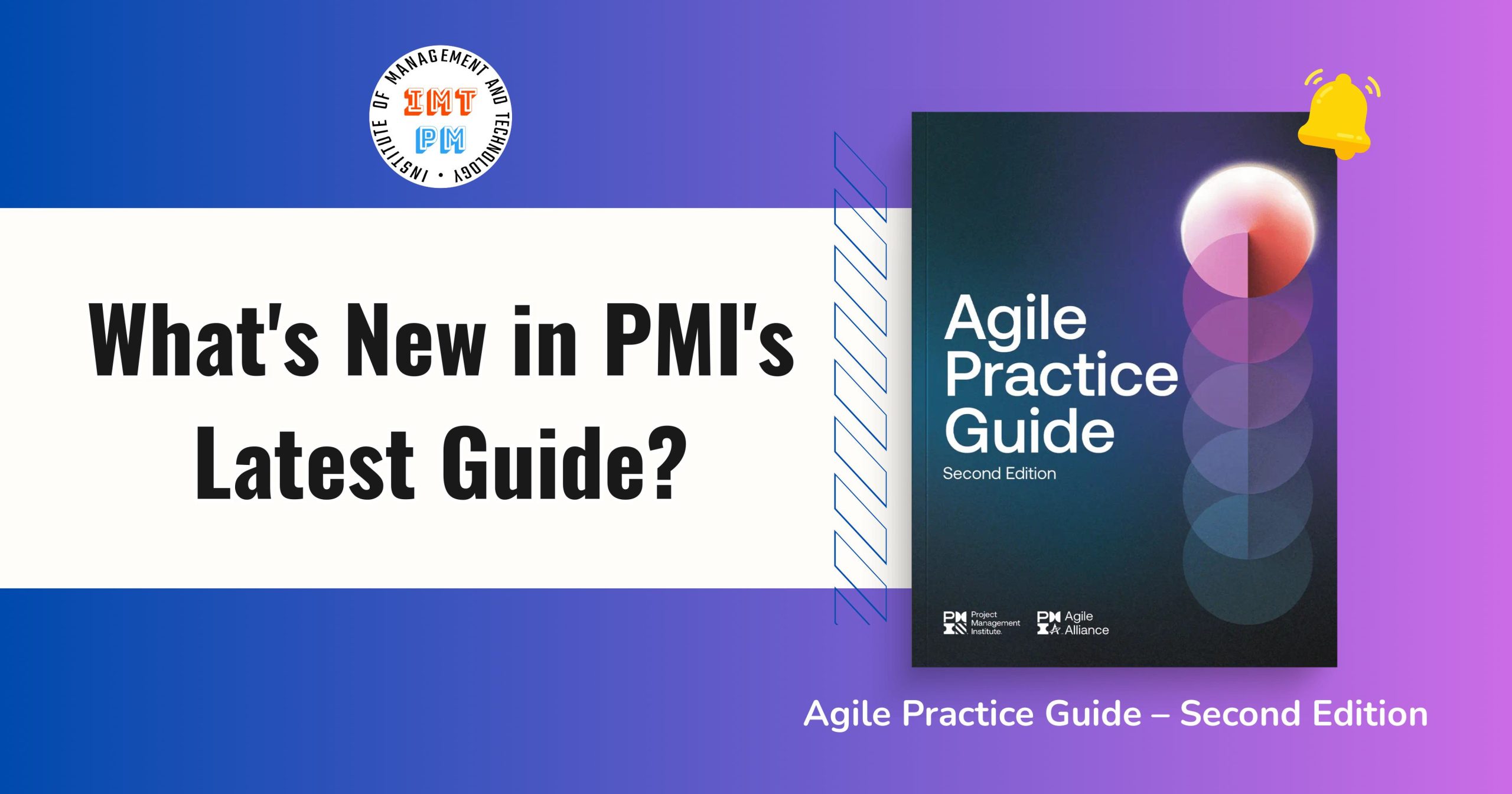
Agile Practice Guide Second Edition: What’s New in PMI’s Latest Guide?
Discover the new Agile Practice Guide Second Edition from PMI®. Explore key updates, AI integration, hybrid delivery, DevOps, and why it matters for project professionals.
Agile Practice Guide – Second Edition: PMI® Releases a New Era of Agile Guidance
The Project Management Institute (PMI®) has officially released the Agile Practice Guide – Second Edition, marking the first major update since the original guide was published in 2017.
As organizations increasingly embrace Agile, Hybrid, AI-powered delivery, and product-centric operating models, the new edition reflects how modern project management has evolved beyond traditional software development.
Whether you’re a Project Manager, Scrum Master, Product Owner, Agile Coach, or PMP®/PMI-ACP® certification candidate, this updated guide provides practical insights into today’s Agile landscape.
What Is the Agile Practice Guide – Second Edition?
The Agile Practice Guide – Second Edition is PMI’s latest guidance for applying Agile approaches across industries and business environments.
Developed in collaboration with the Agile Alliance, the guide complements the latest PMI® standards by helping professionals understand how to choose and apply the most appropriate delivery approach—whether Predictive, Agile, Hybrid, or Product-based.
Unlike framework-specific manuals, this guide offers a framework-neutral perspective, enabling organizations to tailor Agile practices to their unique context.
Why Did PMI® Publish a Second Edition?
Since the first edition was released in 2017, the project management profession has experienced significant transformation.
Today’s organizations face:
- Digital transformation initiatives
- Artificial Intelligence (AI) adoption
- Distributed and remote teams
- Product-led operating models
- DevOps integration
- Continuous delivery expectations
- Faster innovation cycles
To address these changes, PMI® has expanded the guide to include modern practices that better reflect how Agile is implemented in real-world organizations.
Key Updates in Agile Practice Guide – Second Edition
- Beyond Scrum: A Broader View of Agile
The first edition primarily introduced Agile concepts through Scrum.
The Second Edition broadens its perspective by covering multiple approaches, including:
- Scrum
- Kanban
- Lean Thinking
- Design Thinking
- Product Management
- Value Stream Management
- Hybrid Delivery Models
The message is clear:
Agile is a mindset—not a single framework.
Organizations should select practices that best fit their goals rather than strictly following one methodology.
- Greater Focus on Value Delivery
One of the most significant shifts is PMI’s emphasis on delivering business value instead of simply completing projects.
Modern success is measured by outcomes such as:
- Customer satisfaction
- Business impact
- Product adoption
- Time-to-market
- Continuous value creation
This aligns closely with PMI’s broader evolution toward Value Delivery Systems introduced in recent standards.
- Artificial Intelligence Becomes Part of Agile
For the first time, PMI® acknowledges the growing role of Artificial Intelligence (AI) and Generative AI in Agile environments.
The guide discusses how AI can support:
- Sprint planning
- Backlog refinement
- Risk analysis
- Project forecasting
- Decision support
- Knowledge management
Rather than replacing project professionals, AI is presented as a tool that enhances productivity and informed decision-making.
- DevOps and Continuous Delivery
Modern Agile teams increasingly rely on DevOps practices to accelerate software delivery.
The Second Edition introduces concepts such as:
- Continuous Integration (CI)
- Continuous Delivery (CD)
- Continuous Deployment
- Automation
- Feedback loops
- Operational collaboration
It also highlights DORA Metrics, including:
- Deployment Frequency
- Lead Time for Changes
- Change Failure Rate
- Mean Time to Recovery (MTTR)
These metrics help organizations evaluate engineering performance and delivery effectiveness.
- Psychological Safety and High-Performing Teams
Successful Agile adoption depends as much on culture as it does on processes.
PMI® emphasizes:
- Psychological safety
- Trust
- Collaboration
- Team empowerment
- Continuous learning
High-performing Agile teams thrive when members feel comfortable sharing ideas, challenging assumptions, and learning from failure.
- Agile for Hybrid and Remote Teams
Remote and distributed work has become the norm for many organizations.
The guide introduces practical recommendations for:
- Virtual collaboration
- Online facilitation
- Remote retrospectives
- Digital communication
- Distributed Agile teams
These practices help maintain team alignment regardless of location.
- Sustainability and Responsible Delivery
Another notable addition is the consideration of sustainability in project delivery.
Topics include:
- Environmental responsibility
- Ethical decision-making
- Long-term value creation
- ESG awareness
- Sustainable business outcomes
This reflects the growing expectation that organizations deliver value responsibly—not just efficiently.
Agile Practice Guide First Edition vs. Second Edition
First Edition (2017) | Second Edition |
Scrum-focused | Framework-neutral approach |
Team-level Agile | Enterprise-wide Agile |
Limited Product Management | Product-centric delivery |
No AI coverage | AI and Generative AI integration |
Minimal DevOps discussion | DevOps and DORA Metrics |
Limited Hybrid guidance | Extensive Hybrid delivery practices |
Little emphasis on sustainability | Sustainability and ESG considerations |
Who Should Read the Agile Practice Guide – Second Edition?
This guide is valuable for professionals including:
- Project Managers
- Program Managers
- Product Managers
- Scrum Masters
- Product Owners
- Agile Coaches
- PMO Leaders
- Business Analysts
- Digital Transformation Leaders
- PMP® Certification Candidates
- PMI-ACP® Certification Candidates
It is particularly beneficial for professionals working in organizations transitioning from traditional project management to Agile or Hybrid delivery models.
Why This Guide Matters?
The Agile landscape has matured significantly over the past decade.
Organizations are no longer asking:
“Should we adopt Agile?”
Instead, they are asking:
“How do we deliver value faster while adapting to constant change?”
The Agile Practice Guide – Second Edition answers this question by combining proven Agile principles with modern practices such as AI, DevOps, Product Management, and enterprise agility.
Rather than prescribing one methodology, PMI® encourages organizations to choose the right approach based on their context, objectives, and customer needs.
Conclusion
The release of the Agile Practice Guide – Second Edition represents a significant milestone in the evolution of Agile project management.
By incorporating Artificial Intelligence, Hybrid Delivery, DevOps, Product Thinking, Sustainability, and Enterprise Agility, PMI® acknowledges that Agile has become far more than a software development methodology. It is now a strategic capability that enables organizations to innovate, adapt, and continuously deliver value.
For today’s project professionals, this guide is more than an update—it’s a roadmap for navigating the future of project delivery in an increasingly digital and AI-driven world.

Related posts
Agile Practice Guide Second Edition: What’s New in PMI’s Latest Guide?