Course Overview
The Instructor-Led Project Management Professional (PMP)® Exam Prep Course is a comprehensive, structured learning experience designed to prepare learners for success on the PMP® certification exam while building practical project management capabilities. Grounded in the PMP® Exam Content Outline (ECO), the course integrates key domains—People, Process, and Business Environment—into a cohesive learning journey that emphasizes real-world application, critical thinking, and decision-making. Through a blend of instructor facilitation and applied exercises, learners develop a deep understanding of project management principles. The following outline provides an overview of the course structure and key topics covered in the course.
Part 1:
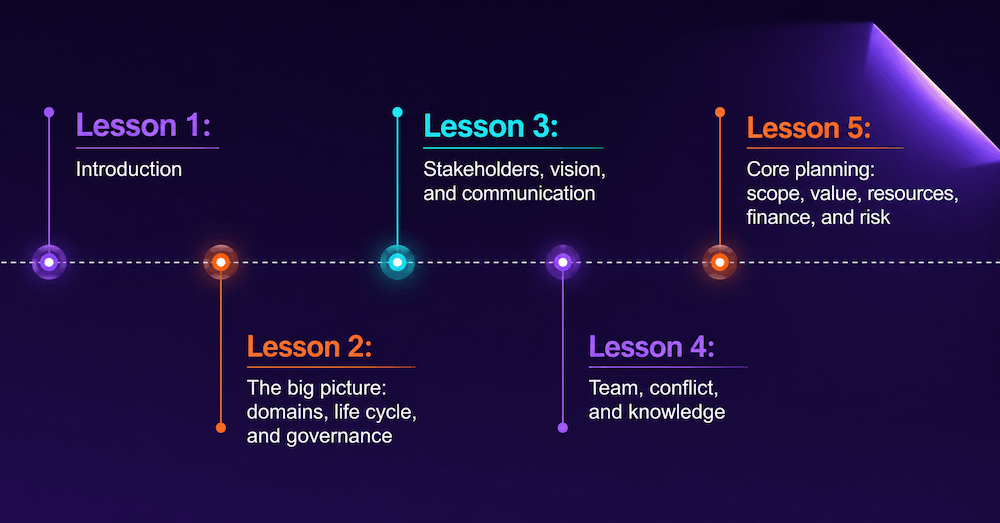
Lesson 1: Welcome
This lesson introduces the PMP® journey and explores the role of the project professional as an agent of change across career, organization, and community contexts.
Topics:
- About your instructor
- About this course
- About the PMP certification
- About the exam
Lesson 2: The Big Picture – Strategy, Value, and Delivery Approaches
This lesson provides context for the rest of the course. It answers fundamental questions like what a project is, what project management is, as well as foundational concepts like project life cycles and development approaches and project governance. Through reflection and discussion, it addresses common misconceptions, aligns expectations, and establishes an understanding of how strategy, value delivery, and project approaches connect to real-world impact.
Topics:
- PMP exam domains
- What is a project?
- Life cycles and development approaches
- Introduction to governance
Lesson 3: Stakeholders, Vision, and Communication
This lesson examines how successful projects are grounded in a clear vision and strong stakeholder alignment. Key PMP® concepts are introduced through practical examples and a realistic project scenario, highlighting the role of communication and stakeholder engagement in driving outcomes.
Topics:
- Identifying and understanding stakeholders
- Developing a common vision
- Planning and managing communication
- Aligning and managing stakeholder expectations
Lesson 4: Teams, Conflict, and Knowledge
This lesson develops capabilities related to leading and supporting high-performing teams. It addresses conflict management, collaboration, and knowledge-sharing practices through realistic scenarios and exam-style questions that reinforce decision-making skills.
Topics:
- Leading and structuring the team
- Managing conflict
- Ensuring knowledge transfer
Lesson 5: Core Planning – Scope, Value, Resources, Finance, and Risk
This lesson establishes a foundation in project planning, including scope definition, value alignment, resource allocation, financial planning, and risk management. Emphasis is placed on the interconnected nature of planning decisions and their impact on project success.
Topics:
- Developing scope and value orientation
- Risk and compliance foundation
- Planning and managing finance
- Planning and managing resources
Part 2: